
Return your old apartment with a clear record
Apartment handover after moving: record, photos and keys
Once the last box is loaded, you still need to hand back the apartment. A clear process helps you document its condition, meter readings and the keys actually returned. Use the checklist and editable worksheet below to prepare your own handover notes.
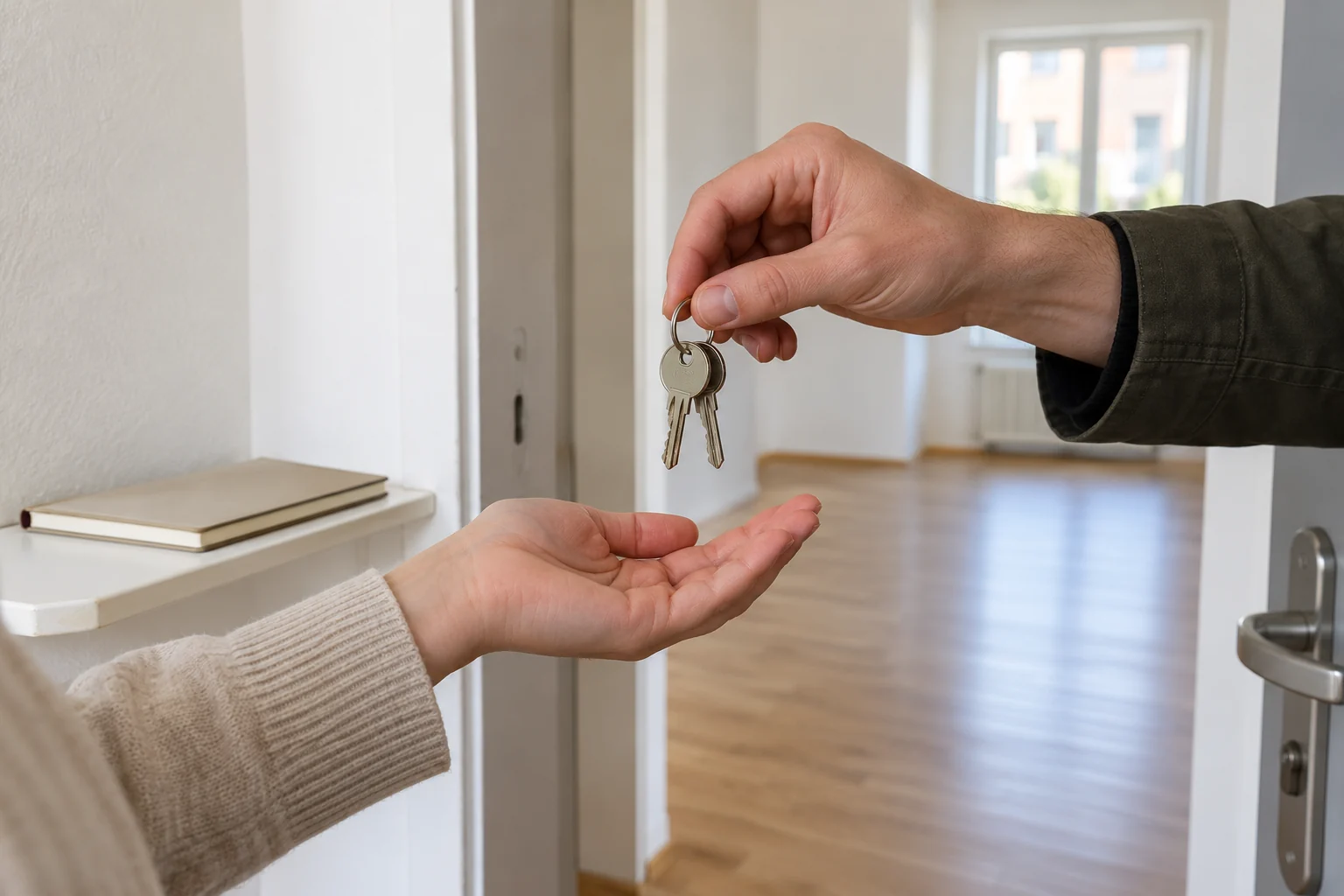
1. Arrange the appointment and prepare the return
Section 546 of Germany’s Civil Code (BGB) requires the rented property to be returned after the tenancy ends. Agree the actual appointment with the landlord or an authorised representative in good time. Confirm who will attend, which spaces are included and who is authorised to receive the keys.
Schedule the handover separately from the moving van’s slot. Allow time after the apartment is cleared for the agreed preparations, the walkthrough and documentation. Record both the tenancy end date and the agreed handover appointment; a transport booking does not settle these arrangements.
- Have the tenancy agreement, move-in record, earlier photographs and subsequent written agreements ready.
- Include the cellar, storage room, parking space and any items rented with the apartment.
- Check access to meters, lighting and the contact person for locked areas.
- Sort keys by what they open and count them before the appointment.
2. Separate the condition from responsibility for repairs
First record what you can actually observe. A description of the condition does not, on its own, establish who must carry out or pay for a repair.
Section 535 BGB includes the landlord’s duty to maintain the rented property. Under section 538 BGB, tenants are not responsible for changes or deterioration caused by use in accordance with the tenancy. This does not automatically classify every mark or scratch: its cause, extent and circumstances can matter.
Moving out does not, by itself, tell you whether you owe particular decorating work. Check the contract, the original condition and later agreements. Standard contract terms must also be valid; section 307 BGB concerns the review of terms that unfairly disadvantage a contracting party. Obtain advice on the individual case if a demand is disputed.
3. Record specific observations room by room
Choose a consistent route, for example entrance, living areas, kitchen, bathroom and ancillary spaces. Identify the object, its precise location and what you can see. Compare it with the move-in documents without assigning a cause that has not been established.
Distinguish between looking at something, trying it briefly and not checking it. Looking at a tap does not confirm that the whole plumbing installation is free from faults. Explicitly leave inaccessible areas open. The following entries are fictional examples of factual wording, not assessments of damage.
| Location and item | Example observation | Reference |
|---|---|---|
| Living room, floor beside balcony door | Pale line approximately 4 cm long; cause not established during the walkthrough | Photos LR-01 and LR-02 |
| Kitchen, left cupboard door | Opened and closed once; hinge not checked further | Note K-01 |
| Cellar compartment | Not inspected today because access was unavailable at the appointment | Follow-up inspection still to be arranged |
4. Connect each photograph to the written record
An overview shows where a feature is; a closer photograph shows the detail. Use a simple reference system such as LR-01 and LR-02 and put the reference beside the corresponding observation. Include the date and room in your photo list instead of relying solely on the order in your phone’s gallery.
Keep the original files unchanged and make a second copy. If annotations would help, add them to additional copies. Take photographs for the purpose of the handover and avoid unnecessary images of personal documents or other people. Share the records only with the intended recipients.
- Take a room overview followed by photographs of relevant details.
- Connect the image number, location and brief description in a photo index.
- Give later photographs their actual capture date and time.
- Check that the files are sharp, complete and readable on a second device or storage location.
5. List meter readings and keys separately
Reading the meters and returning the keys are separate events. Record what actually happened for each.
For each meter you read, record the utility, meter number, displayed reading and unit, plus the date and time. Link the corresponding photograph. Where there are several displays, include the display identifier. If a meter is inaccessible or unreadable, do not enter an invented zero; record the reason and what still needs to be clarified.
Count the keys together again when they are actually handed over. List apartment, building entrance, mailbox, cellar and other access separately, including any fobs or remote controls. Record the recipient, date and time. Explicitly note missing keys or differences from the original inventory.
| Entry | Details to keep together |
|---|---|
| Meter | Utility · number · display identifier · reading · unit · reading time · photo ID |
| Key or access device | Purpose · quantity actually returned · recipient · handover time · unresolved discrepancy |
6. An editable draft for your handover notes
Use the blank fields as a working document. Add entries for each room, meter or type of key as needed. The draft contains no prewritten acceptance of a payment obligation and no declaration that all visible or hidden defects have been ruled out.
Copy your entries into your own document before leaving this page. Add the attachments there and review the final shared version before signing it. The worksheet alone is not a handover record agreed by both parties.
Worksheet: condition and actual handover
These fields do not submit your entries or save them automatically. Copy their contents into your own document before closing or reloading this page or switching languages.
Address, floor, apartment identifier, cellar, parking space and other areas included in the tenancy.
Date and start/end of the walkthrough; record the time of the actual return separately.
Names, roles and any confirmed authority to represent a party; only necessary contact details.
Identify the move-in record, earlier photographs, inventory and relevant written agreements.
Room, item, precise location, observation and photo ID; add further entries as needed.
What was inaccessible or not checked? Record the reason and what remains to be clarified.
For each meter: utility, number, display, reading, unit, date, time and photo ID.
For each type: actual quantity, recipient and handover time; identify missing or unaccounted-for items.
Filename or image number, room, detail and actual capture date and time.
Attribute each position to the relevant person; leave unresolved cause or responsibility open.
Proposed or already agreed? Give the task, responsible person and only a date that has actually been agreed.
Version, attachment list and recipients; explicitly identify documents not yet provided.
7. Review disputed points and signatures carefully
Read every page and attachment before signing. Separate observed conditions, differing views and further steps that have actually been agreed. Accepting costs, waiving a right or promising specific work goes beyond a simple condition note. Clarify wording that you do not understand or agree with before accepting it.
Berliner Mieterverein explains that there is no general obligation to sign a handover record. If you disagree, you can preserve your own documentation and seek legal advice. An example note could read: “Landlord describes the mark as new; tenant refers to move-in photo E-03; no agreement on the cause.” This example does not determine liability.
If the other party does not attend, contact the landlord to arrange the return, including the keys. Record attempts to make contact and what actually happens. An unanswered message or your own condition list does not automatically fulfil the obligation to return the property.
8. Save the records and assign outstanding tasks
Make sure everyone receives the same final version and attachments. Store the handover record, photo index, original images, meter readings and evidence of the key return together. Identify later additions as additions instead of silently changing the original version.
Only transfer tasks that were actually agreed into your follow-up list, with the responsible person and agreed date. Submit readings to utility providers through their respective procedures; writing them in the handover record does not automatically notify the providers. Address questions about the transport contract separately with the company carrying out the move.
umzughilfen.de forwards enquiries to independent partners. The named partner issues the quote, enters into the contract, performs the service and invoices you; payment goes directly to that partner. umzughilfen.de remains responsible for its own referral activities and data processing.
Common questions about apartment handovers
Do I always have to repaint when I move out?
No. Moving out does not by itself create a general duty to repaint. The contract, validity of the relevant terms, initial condition and circumstances need to be considered. Seek individual advice if a demand is disputed.
Do I have to sign the handover record I am given?
Berliner Mieterverein states that there is no general duty to sign. Read the record and clarify inaccurate or unclear entries before agreeing. A disagreement about the record does not remove the obligation to return the apartment.
What should I enter for an inaccessible meter?
Record that no reading was possible, why, and what access still needs to be arranged. Do not invent a reading. Give any later reading its actual date and time.
Are my worksheet entries saved?
The worksheet does not submit entries or save them automatically. Copy the contents into your own document in good time. Switching languages or reloading the page may also discard your entries.
Sources and scope
Checked on 23 September 2026. The legislation concerns Germany. The workflow, examples and worksheet are editorial aids; they do not replace a review of a specific tenancy agreement or disputed demand.
- Section 546 BGB: tenant’s duty to return the property
- Section 538 BGB: deterioration through use in accordance with the tenancy
- Section 535 BGB: main obligations under a tenancy
- Section 307 BGB: review of contract terms
- Mieterbund Darmstadt: handover when moving out (23 May 2024)
- Berliner Mieterverein: ten questions about returning an apartment (28 November 2018)