
Plan both space and weight when choosing a vehicle
Moving with a 3.5-tonne van: cargo space and payload
A 3.5-tonne van cannot automatically carry 3.5 tonnes of furniture. The designation refers to its maximum permitted total mass, including the vehicle, people and everything on board. The remaining capacity for your belongings depends on the actual vehicle and its current configuration. Empty cargo space does not answer that weight question.
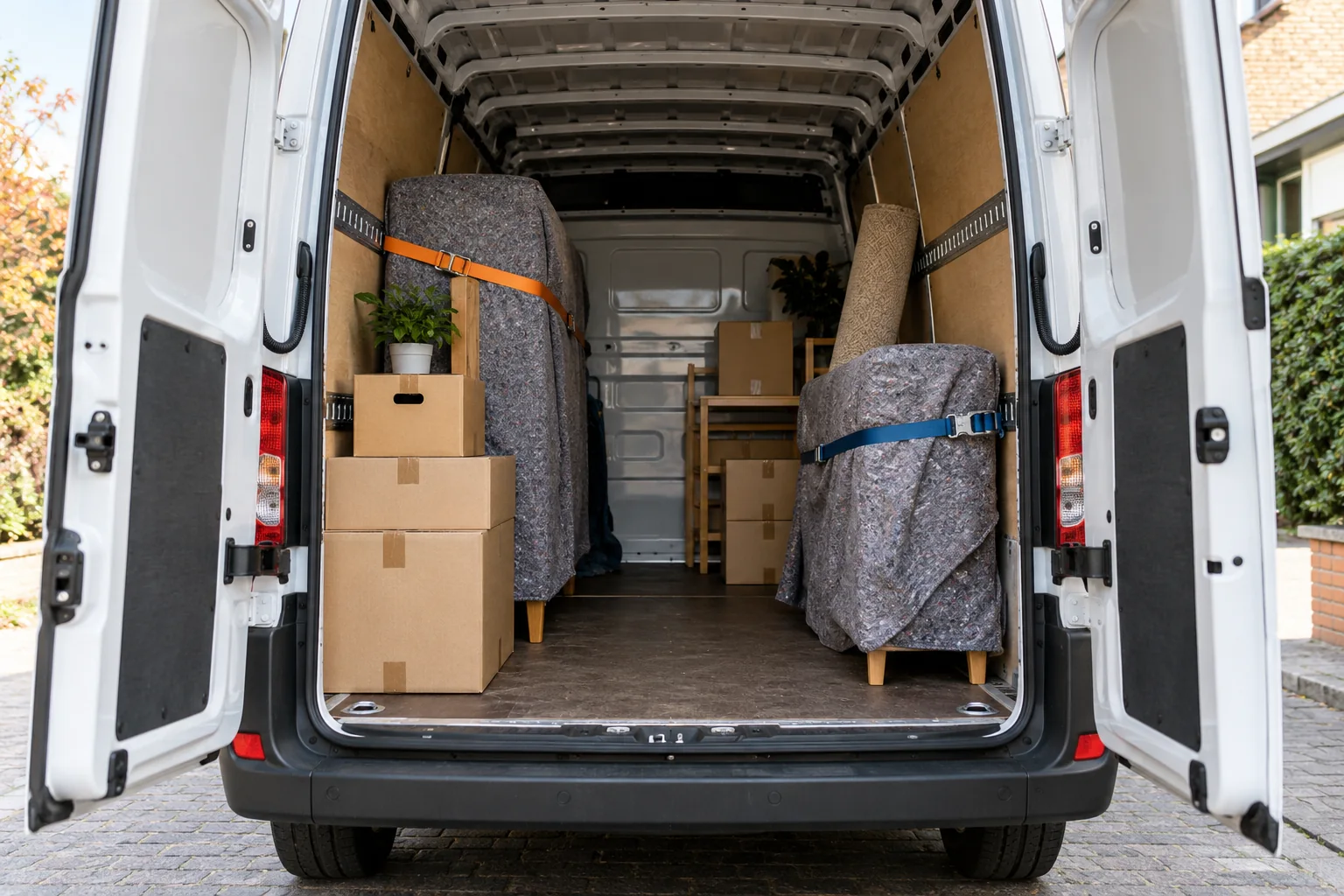
1. Will it fit, and is it within the weight limits?
A vehicle category, a home size or the phrase “large van” does not replace an inventory and the details of the vehicle actually used.
Cubic metres measure space; kilograms measure mass. Identically sized boxes of books and bedding can weigh very different amounts. There is no reliable universal conversion factor from moving volume to kilograms.
Check shape as well: a long item may not pass through the loading door even when the cubic capacity looks sufficient. Wheel arches, packaging, items that cannot be stacked and room for suitable load securing affect the usable space.
- Space: compare the packed items' dimensions with the interior and loading openings.
- Weight: record known masses, label estimates and resolve missing information.
- Trips: determine what can travel together only after checking both space and weight and planning the arrangement.
2. Check the relevant German registration fields
A higher technical figure at F.1 does not simply override a lower F.2 value. The recorded unladen mass is also not a current weighing result for your fully prepared van.
Use the actual vehicle's Zulassungsbescheinigung Teil I. The table summarises selected fields from Annex 6 FZV. Ask the rental company or transport provider to explain any differing figures or special entries and the limits that apply.
Subtracting G from F.2 gives a starting figure. It does not establish how many kilograms of furniture you can add today. Compare the vehicle condition behind that figure with its actual equipment and occupants. Do not deduct an item twice if it has already been accounted for.
| Field | Meaning in brief |
|---|---|
| F.1 | Technical maximum total mass |
| F.2 | Maximum total mass permitted in the registration state |
| G | Recorded in-service vehicle mass / unladen mass |
| 7.1 / 7.2 | Technical limits for axles 1 / 2 |
| 8.1 / 8.2 | Permitted axle loads in the registration state, axles 1 / 2 |
| 22 | Remarks and exceptions |
3. Worked example: why 1,080 kg becomes 720 kg
The 720 kg is only calculated headroom below the total-mass limit. It does not approve a particular load: an axle may reach its limit sooner, as the next example shows.
This is an invented calculation model, not a rental offer or a specification for a vehicle model. Assume F.2 is 3,500 kg and G is 2,420 kg. For the intended trip, assume an actual starting mass of 2,780 kg: all occupants, the planned fuel level, tools, moving aids and securing equipment are already included, but the household goods are not.
The initial headroom for adding those goods is the difference between 3,500 and 2,780 kg. Do not add the driver, helpers and equipment again. Do not subtract G again from a figure that already represents the actual vehicle mass. The 600 kg of goods below includes their packaging.
| Step in the example | Calculation or value | Interpretation |
|---|---|---|
| Permitted total mass F.2 | 3,500 kg | Limit for the entire vehicle |
| Recorded unladen mass G | 2,420 kg | Document figure, not today's starting mass |
| Difference between document figures | 3,500 − 2,420 = 1,080 kg | Not yet a confirmed furniture allowance |
| Actual starting mass without household goods | 2,780 kg | Occupants and carried equipment already included |
| Headroom below the total-mass limit | 3,500 − 2,780 = 720 kg | Axle limits and load arrangement still need checking |
| After 600 kg of packed household goods | 2,780 + 600 = 3,380 kg | 120 kg below the total-mass limit |
| Adding another 180 kg | 3,380 + 180 = 3,560 kg | 60 kg above the total-mass limit: do not drive like this |
4. An axle can be overloaded below 3.5 tonnes
Adding the two axle limits does not increase the permitted total mass. Spare capacity at the front axle does not cancel a rear-axle overload. The load must be corrected by someone competent and checked again before driving.
Section 34(3) StVZO requires compliance with both total-weight and axle-load limits. ADAC explains that added mass does not affect the axles equally. Dividing the total by two is therefore not a reliable axle check for a two-axle van.
For the same fictional van, we now add hypothetical axle limits and measurements after loading the 600 kg of goods. This distribution is solely an arithmetic example, not loading advice.
| Check | Assumed limit | Assumed measurement | Result |
|---|---|---|---|
| Front axle | 1,850 kg | 1,330 kg | Below the limit |
| Rear axle | 2,000 kg | 2,050 kg | 50 kg too much |
| Total | 3,500 kg | 1,330 + 2,050 = 3,380 kg | 120 kg below; the axle overload remains |
5. Check weighing and load securing separately
ADAC recommends weighing the loaded vehicle and its axles before travelling. Ask a suitable weighing operator in advance about vehicle dimensions, measurement options and the procedure. A total weight alone on a weighbridge ticket does not establish the individual axle loads.
Record who was on board, what equipment was included and the fuel level during weighing. People, items or fuel added later change the calculation. Do not set off with unclear or exceeded limits just to look for a weighing facility on the way.
Section 22 StVO requires stowage and securing that account for heavy braking and sudden avoidance manoeuvres. A vehicle within its mass limits can still have an improperly secured load. Have the actual securing arrangement planned with suitable equipment and the vehicle's instructions.
- Include all items, their packaging and any material travelling with them.
- Record the actual vehicle configuration; check again if a replacement vehicle is supplied.
- Observe the total mass, each axle load and other applicable vehicle limits.
- Check usable openings, load space and whether the load can be secured.
- Do not treat measurement uncertainty or unknown weights as spare capacity.
- Confirm who will check loading and securing before departure.
6. When space or weight capacity is insufficient
“It all fits in one van” should refer to the inventory, vehicle, weights and loading plan. Cubic metres alone cannot establish the number of trips.
If space is the problem, another arrangement or vehicle configuration may help, provided the items and securing requirements allow it. If weight is the problem, tighter stacking creates no extra payload. With the same permitted total mass, a heavier body can actually reduce the remaining capacity.
Possible solutions include additional trips, a suitably equipped alternative vehicle or splitting the load across suitable vehicles. Each trip needs its own checks. Agree extra mileage, time, loading help and return deadlines before booking.
Dismantling furniture changes its shape but does not automatically reduce the combined mass of all the parts you take. More helpers do not solve a weight problem either; if they travel in the van, they form part of its total mass. Plan the vehicle and team together.
7. Include these details in a transport enquiry
Provide an inventory with dimensions, known weights and clearly labelled estimates. Identify heavy individual items, packing status, addresses, access and the date. Ask which actual vehicle and trips the provider proposes and how remaining payload and axle loads will be checked.
Umzughilfen is a marketing and referral service. A named independent partner issues its own offer and contracts directly with you. That partner carries out the work, invoices you and receives payment; Umzughilfen remains responsible for its own referral and data protection duties. You receive the partner's name and address before a binding booking.
An enquiry does not yet confirm a vehicle, payload or appointment. Have the inventory used and the offered scope confirmed, and report later changes.
Moving-van payload questions
Can a 3.5-tonne van carry 3.5 tonnes of furniture?
No. Its permitted total mass includes the vehicle, people and everything on board. The remaining capacity for household goods must be established for the actual vehicle, with axle limits and other relevant restrictions also observed.
How many kilograms are in a cubic metre of household goods?
There is no reliable universal conversion. The same amount of space can contain very different masses depending on the contents. Record volume and weight separately and mark unknown values.
Does F.2 minus G give the available furniture payload?
It gives an initial difference between document figures. Actual equipment, occupants and carried material must be accounted for on the current trip. Suitable weighing establishes the current mass; individual axle loads need separate checking.
Do I include the driver and helpers?
Everyone travelling in the vehicle counts towards its actual total mass. If they were already on board for the weighing result you use, do not count them again. When calculating from document values, establish what those values already include.
Can I add the axle limits to get the permitted total mass?
No. Permitted total mass remains a separate limit, and each axle must also stay within its own limit. Spare capacity at one axle or below the total-mass limit does not offset an overload at the other axle.
Sources and assumptions
Sources checked on 28 September 2026. The fields refer to the German Zulassungsbescheinigung Teil I. Every vehicle, cargo and axle figure in the examples is an original hypothetical assumption, not a specification for a vehicle owned by Umzughilfen or a partner. Use the documents, actual measurements and conditions of the vehicle provided.