
List the items before choosing the vehicle
Estimate moving volume with a room-by-room inventory
How many cubic metres are you actually moving? Floor area alone cannot tell you. List furniture and packed boxes room by room, measure them as they will travel and flag anything still uncertain. This gives an independent moving partner a useful basis for transport planning and a specific quote.
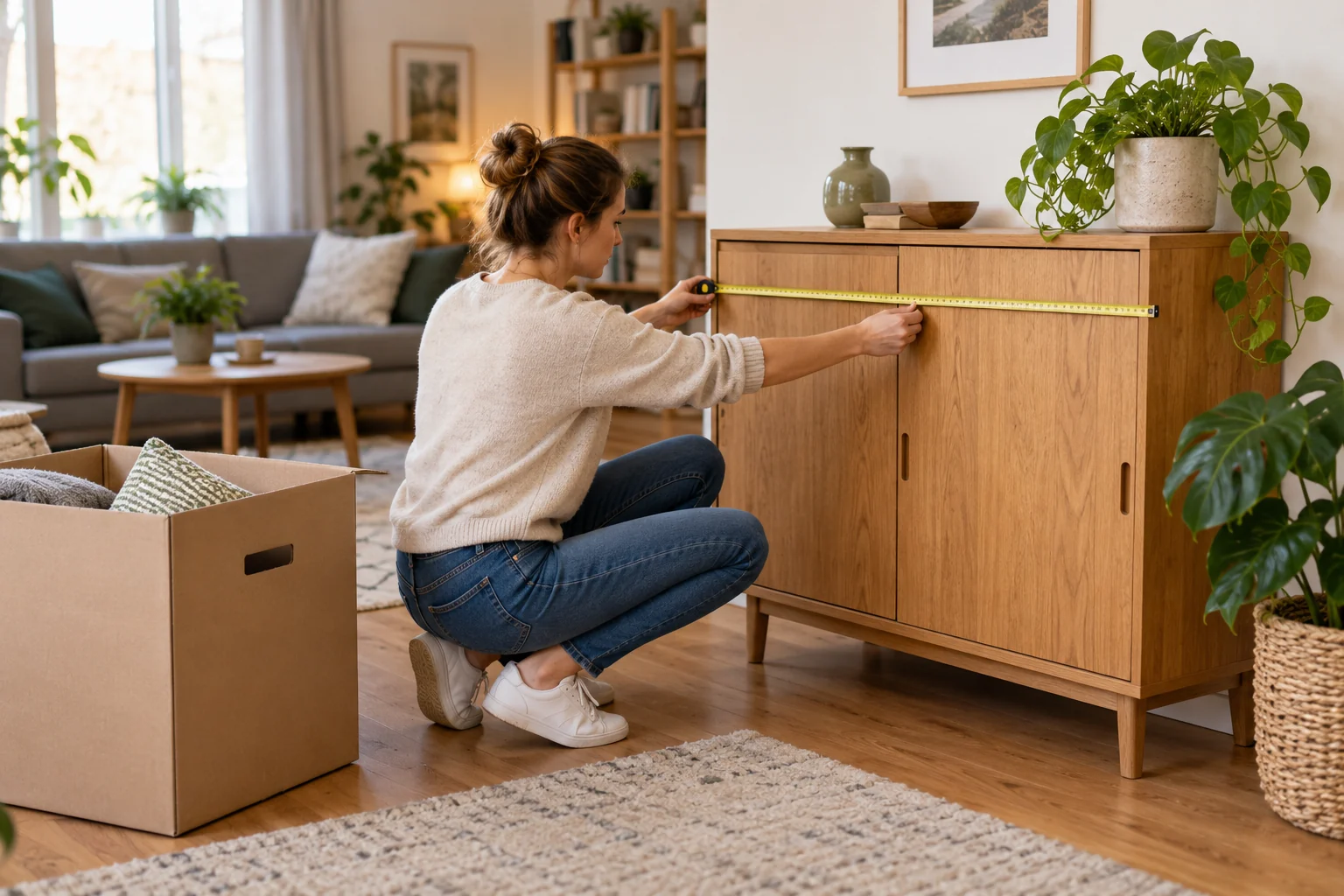
1. Build an inventory room by room
Walk through every room, including the cellar, attic, balcony and garage. Record only items that will come with you. Put undecided items in a separate group rather than silently leaving them out.
Each line should identify the room, item, quantity, transport condition and dimensions. Add a known weight and notes such as “glass”, “cannot be stacked” or “dismantling undecided”. Number items so photographs can be matched to the list.
- Living room: sofa, shelves, tables, lamps and wrapped pictures.
- Bedroom: bed parts, mattresses, wardrobe panels and clothing boxes.
- Kitchen: packed boxes and only the appliances or furniture actually included in the move.
- Storage areas: tools, bikes, suitcases, plants and stored containers.
- Finish with a count of packed boxes and a separate estimate for belongings not yet packed.
2. Use external dimensions in transport condition
For a rectangular item, length × width × height in metres gives its volume in cubic metres. If all measurements are in centimetres, divide their product by 1,000,000. A 60 × 40 × 40 cm box occupies a geometric volume of 0.096 m³; ten identical boxes total 0.96 m³.
Include existing packaging in the measurements. For dismantled furniture, record the actual planned bundles instead of counting both those bundles and the assembled item. Contents packed separately belong in the box count.
For irregular shapes, the outermost dimensions describe a surrounding rectangular envelope. Whether gaps can be used or items nested depends on the actual loading plan. Do not assume stackability simply to obtain a smaller number.
3. A small, deliberately incomplete inventory example
The 3.000 m³ total is the sum of the external rectangular envelopes. It does not mean a vehicle with a 3 m³ load space will be sufficient.
These dimensions are hypothetical. All items have been measured in transport condition, with no further packaging assumed. This is a sample subset showing the method, not the contents of a typical home.
| Room / item | Quantity | External size per item | Combined volume |
|---|---|---|---|
| Living room / sofa | 1 | 2.00 × 0.90 × 0.80 m | 1.440 m³ |
| Kitchen / packed boxes | 10 | 0.60 × 0.40 × 0.40 m | 0.960 m³ |
| Bedroom / furniture bundles | 3 | 2.00 × 0.60 × 0.10 m | 0.360 m³ |
| Cellar / closed containers | 4 | 0.50 × 0.40 × 0.30 m | 0.240 m³ |
| Geometric total | 3.000 m³ |
4. Why the total differs from the load space needed
There will be gaps in a vehicle. Furniture has different shapes, fragile pieces cannot support arbitrary loads, and restraints need room. Wheel arches, door openings and usable interior dimensions also affect the arrangement.
Keep the measured total separate from the estimated loading-space requirement. Ask the partner to explain the allowance and arrangement assumed for your inventory. One standard percentage cannot suit every load.
Check long or bulky items individually: a cubic-metre total does not show whether a sofa fits through the van door. Nor does the total alone establish how many trips will be needed.
5. Record weight separately
Cubic metres measure space; kilograms measure mass. Boxes of books and bedding can occupy the same space while weighing very different amounts. Use reliable product information or suitable scales, and label estimated weights.
Remaining payload depends on the specific vehicle and its actual loaded condition. People, equipment and materials on board must be accounted for. Total permitted mass and axle limits still apply when there is empty space. ADAC explains these separate limits.
A “3.5-tonne van” refers to its permitted total mass, not permission to carry 3.5 tonnes of furniture. Have the performing partner check the vehicle, available payload and load distribution against your inventory.
6. Flag unpacked belongings and difficult access
While packing is unfinished, keep two counts: boxes already packed and estimated additional boxes. Replace estimates with actual counts after packing. Use separate lines for different box sizes.
Add photographs of large items and measurements of tight doors, stairs and lifts at both addresses. These do not increase the furniture volume but can change carrying, dismantling and labour requirements. Photograph the items rather than personal documents.
7. Turn the inventory into a clear enquiry
Date the inventory and send the same version to every company you approach. Identify items you will transport yourself. If important questions remain, an inspection or focused video discussion may help.
Ask which inventory, dismantling tasks and trips are included in the quote. Germany’s Verbraucherzentrale recommends recording agreed moving services in the written offer. Send later changes and clarify how they affect the proposal.
8. What Umzughilfen does
Umzughilfen provides marketing and referral services. Your inventory supports a non-binding enquiry; it is not a booking or a binding promise about vehicle size or price.
The independent performing partner is identified by name and address before a binding booking. The quote, moving contract, performance, invoice and payment are handled directly with that partner. Umzughilfen remains responsible for its own referral and data-protection duties.
Moving volume: common questions
Can I calculate moving volume from floor area?
Floor area offers only a rough starting point. Furniture, books, storage rooms and items left behind vary substantially. An inventory with transport dimensions is a better basis.
Should I count both a wardrobe and its dismantled bundles?
No. Record either the assembled item or its planned transport bundles. Contents packed separately must additionally appear in the box list.
How much extra space should I allow?
There is no single allowance for every load. Packaging, shapes, stackability and vehicle geometry all matter. Ask the partner to explain the assumed arrangement and allowance.
Is enough cubic capacity all I need?
No. Individual dimensions, door openings, safe loading, total mass and axle limits must also work. A volume total alone does not confirm a vehicle choice.
Sources and context
Sources checked on 22 September 2026. The inventory method and hypothetical figures are editorial planning aids, not a vehicle recommendation or price calculation. Linked sources are in German.