
Give the provider a clear basis for a quote
Prepare a moving enquiry: details, measurements and photos
“Two rooms and some boxes” leaves a lot unanswered. A useful moving enquiry explains what is coming with you, how it will leave the old home and enter the new one, and which tasks you want to book. Use this checklist to gather the relevant details and identify what still needs checking.
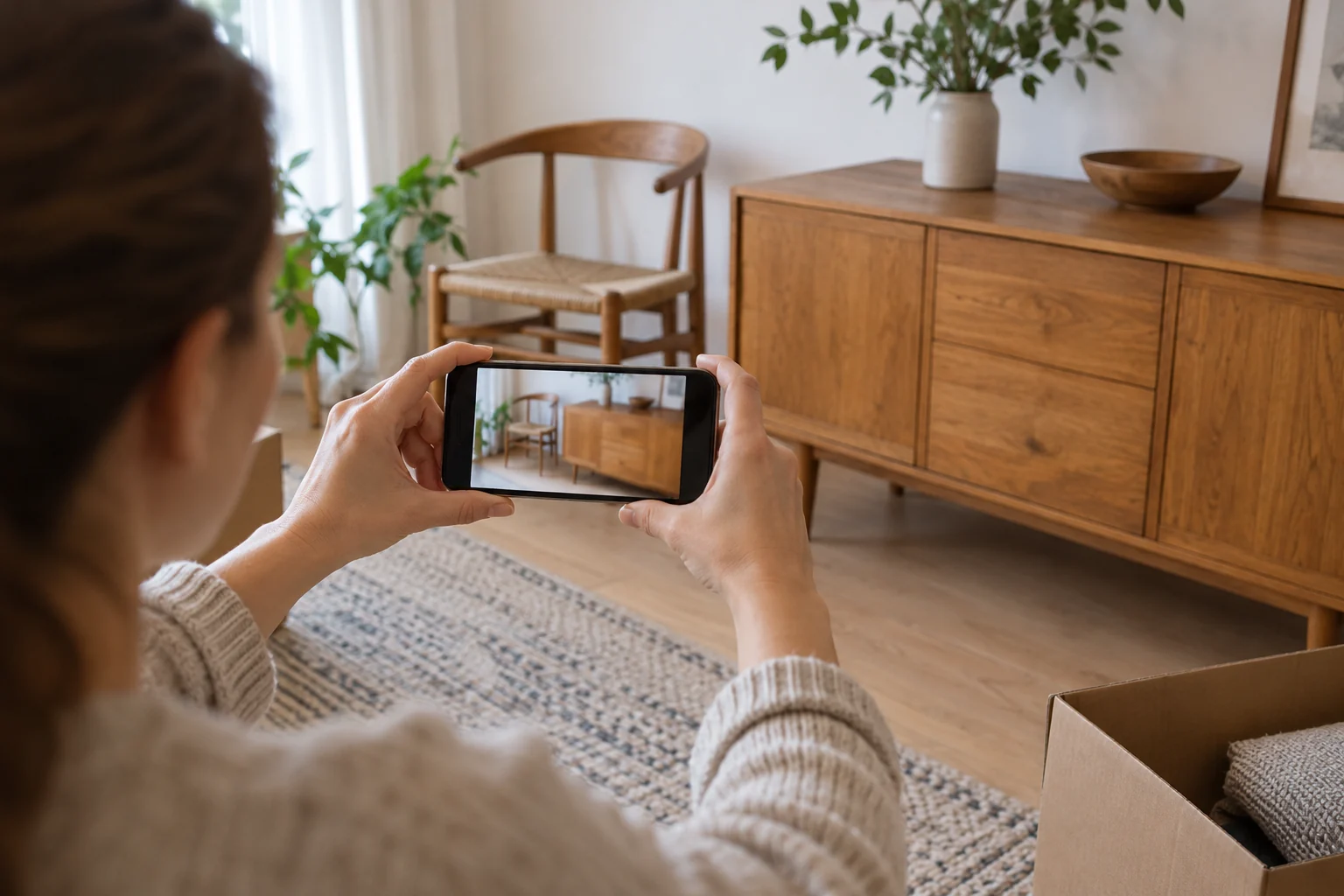
1. Start with the route, date and contact details
Start with the collection location, destination, preferred date and a way to reach you. Towns and postcodes help with an initial outline. The quoting company may need the full addresses to assess the route and access properly. Send them to the intended recipient through an agreed contact channel.
Include the year with your preferred date and list possible alternatives. Mention a fixed key handover or a restricted lift-use window. Requesting a date does not reserve it.
Germany's Verbraucherzentrale recommends discussing individual moving services and recording them in writing. Give every company you approach the same dated description.
- Where from and to? List any additional collection or delivery stops separately.
- When? Give your preferred day, time window and flexibility.
- Who can answer questions? A name and a suitable contact method are enough for the initial discussion.
- What is unknown? Mark missing details and say when you can supply them, if known.
2. Build an inventory room by room
Walk through every room, including the cellar, attic, balcony and garage. List only belongings that are moving, and identify anything visible in a photo that will stay behind. Floor area is no substitute for an inventory.
Assign simple identifiers, such as W01 for a wardrobe or S01 for a sofa. Record quantities, dimensions, intended transport condition and special features. Using the same identifier in a photo filename makes it easier to match the picture to the item.
Keep the count of packed boxes separate from your estimate of boxes still needed. Add their approximate sizes. For heavy or delicate items, record the material, model and any known manufacturer specifications. Mark an unknown weight as unknown.
- Furniture: quantity and transport condition — assembled, dismantled or still to be agreed.
- Boxes: already packed, additional estimated quantity and any different sizes.
- Special items: list pianos, aquariums, large plants or furniture that cannot be dismantled individually.
- Storage areas and extra stops: clearly assign the belongings to each location.
3. Describe access at both addresses
Follow the route from each furniture item to the possible loading position, and reverse the process at the destination. Describe floors unambiguously, for example “two storeys above ground level”. Note steps outside the entrance, tight turns, landings and long corridors.
“There is a lift” is not enough for large items. The clear door opening, usable cabin dimensions and a known load limit are more useful. Check whether the lift can be used on moving day. Take a load limit only from a reliable source, such as the lift's posted rating.
Estimate the carrying distance between the likely loading position and the entrance in metres, marking it as an estimate. A photo of an empty street does not secure a parking space. If destination details are missing, ask the relevant contact instead of assuming access or parking will be available.
- Describe collection and delivery separately: floor, stairs, doors and lift.
- Note narrow points and obstacles along the entire carrying route.
- Record vehicle access, the loading position, approximate carrying distance and known time restrictions.
- Arrange clarification of parking or temporary no-parking requirements early.
4. Choose photos that answer specific questions
Photos do not replace measurements or confirm feasibility or a binding price. The company may suggest further checks or a survey if narrow access remains unclear.
Select pictures with a clear purpose. A view of the item and a picture of the difficult part are often more useful than several near-identical shots. Photograph only safely accessible areas and describe hidden parts in writing.
The following list helps you choose useful pictures; it is not a requirement to document your entire home. Ask the recipient which images are actually still needed.
| Subject | What the image should show | Useful accompanying detail |
|---|---|---|
| Furniture item, such as W01 | Overall shape and intended transport condition | Dimensions; dismantlable or unclear; contents counted separately |
| A special feature | An accessible joint, glass panel or fixed projection | Why it matters for dismantling or protection |
| Stairs and a turning point | Route, landing and fixed obstacles | Narrowest measured points and floor level |
| Door or lift | Clear opening and usable interior | Measured width, height and cabin depth |
| Route to the loading position | Entrance, steps and carrying route | Estimated distance; space availability unknown or confirmed |
5. Record measurements clearly and safely
One width measurement cannot establish whether furniture will turn around a staircase corner. Have the whole transport route assessed.
Write furniture dimensions as width × depth × height in centimetres. For openings, explicitly label width and height. Measure the intended transport condition. If dismantling is planned, record the dimensions you know and mark the sizes of the transportable parts as still to be checked.
Measure from a stable, safe position. Do not tilt heavy furniture, disconnect appliances or climb on improvised supports for a photograph. Inaccessible dimensions or rear panels can be discussed with the company later.
| What to measure | How to record it | Points to watch |
|---|---|---|
| Furniture | Width × depth × height, all in cm | Include fixed handles and projections; identify removable parts |
| Doorway | Actual clear width and height in cm | Do not give only the door leaf's dimensions |
| Lift | Clear door opening and usable cabin width, depth and height | A large enough cabin says nothing about the route to it |
| Stairs and landings | Narrowest usable width, landing dimensions and low points | Describe turns and space for manoeuvring too |
| Carrying route | Approximate distance in metres | Record steps, slopes and interruptions separately |
6. Separate your own work from requested services
For each task, say whether you will do it yourself or want it included in a quote. “Full move” is too vague without a breakdown. Identify the specific furniture involved in dismantling and reassembly by its inventory code.
List appliance disconnection or connection as separate tasks. Ask whether the provider undertakes them and what conditions apply. Booking transport does not automatically confirm those jobs.
- Packing: who packs which belongings, and who supplies which materials?
- Carrying and transport: from which rooms to which destination rooms?
- Furniture work: which items need dismantling, protection and reassembly?
- Unpacking and material collection: requested, handled by you or not being booked?
- Special tasks: confirm responsibility, requirements and price before booking.
7. Use this sample enquiry structure
All quantities and dimensions are illustrative. They are not recommended amounts for a particular flat size or confirmation that these items can be transported along a given route.
This example outlines a hypothetical move from Idstein to Wiesbaden. It is neither a complete inventory nor a quote. Replace every example value with your own details and add missing items.
A useful follow-up sentence would be: “Please tell me which details about the destination are still needed and whether a survey is required before you quote.” This turns a missing detail into a clear question.
| Field | Fictional example |
|---|---|
| Version and date | Date this brief; add the preferred moving day with year and possible alternatives |
| Route | Idstein → Wiesbaden; full addresses through the agreed contact channel |
| Collection | Two-room flat, two storeys above ground level, no lift; estimated carrying distance 25 m |
| Destination | One storey above ground level; lift present, door and cabin dimensions unknown; loading space unresolved |
| Inventory extract | S01 sofa: 210 × 90 × 85 cm (W × D × H), carried assembled; W01 wardrobe: 180 × 60 × 210 cm, dismantling and reassembly requested; add other items separately |
| Boxes and photos | 18 boxes packed, 12 more estimated; add box sizes. Photos: S01, W01 and stair turn |
| Tasks and open questions | Pack boxes ourselves; request carrying, transport and W01 assembly work. Clarify destination dimensions and loading space before confirming the quote |
8. Check personal details and keep the brief current
Review pictures before sending them. Identity documents, letters, bank details, screens, keys, access codes and uninvolved people do not belong in a photo list for a moving estimate. Choose a suitable crop and check reflections too. No identity-document or tenancy-agreement copy is needed for this enquiry.
Camera photos can contain stored location data. Check the file and sharing settings, and remove unnecessary location information before sharing. Visible details within a picture can also reveal where it was taken.
The Umzughilfen enquiry form does not have a photo-upload field. Start by describing the inventory in text. If further information is needed, agree which named company or contact should receive the relevant pictures and through which channel. Do not create a publicly accessible home photo album for this purpose.
Umzughilfen refers enquiries to independent partners. Details needed to process an enquiry are passed to a selected partner as described in the privacy policy. Before a binding booking, you receive that partner's name and address. The quote, moving contract, work, invoice and payment are directly with that partner. Umzughilfen remains responsible for its own referral and data-protection duties.
If the inventory, date, address or access changes, send a dated update to the affected providers. Ask them to confirm which version their quote covers. The enquiry itself is not a booking.
Common preparation questions
How many photos do I need for a moving enquiry?
There is no fixed number for every move. Start with an inventory and targeted images of large or unusual items and difficult access. Ask which additional pictures are needed for your specific quote.
What if I do not know the weight or destination dimensions?
Mark the detail as unknown. Use available manufacturer information and ask the relevant contact about the destination. Do not invent values. The quoting company should clarify whether more measurements or a survey are needed.
Can I upload pictures directly in the enquiry form?
The Umzughilfen form has no photo-upload field. Describe the inventory and special features in text, then agree with the named contact which pictures should be sent through which channel if needed.
Do complete details guarantee a fixed price or an available date?
No. The information supports an assessment. The independent partner confirms pricing, scope and availability in its own quote or agreement. An enquiry through Umzughilfen does not reserve a date.
Sources and scope
Sources checked on 25 September 2026. The checklists, measurement entries and sample enquiry are editorial planning aids. Confirm directly with the company what it needs for your particular move. The location-data source describes Google Photos; settings on other devices and services may differ. Sources are in German.