
Packing & materials
How to pack leather handbags for a move without crushing them
A leather handbag is not spare storage space for moving day. Empty it, support its natural shape and give it a dedicated place in a box. This guide covers preparation through to unpacking; care instructions depend on the particular bag.
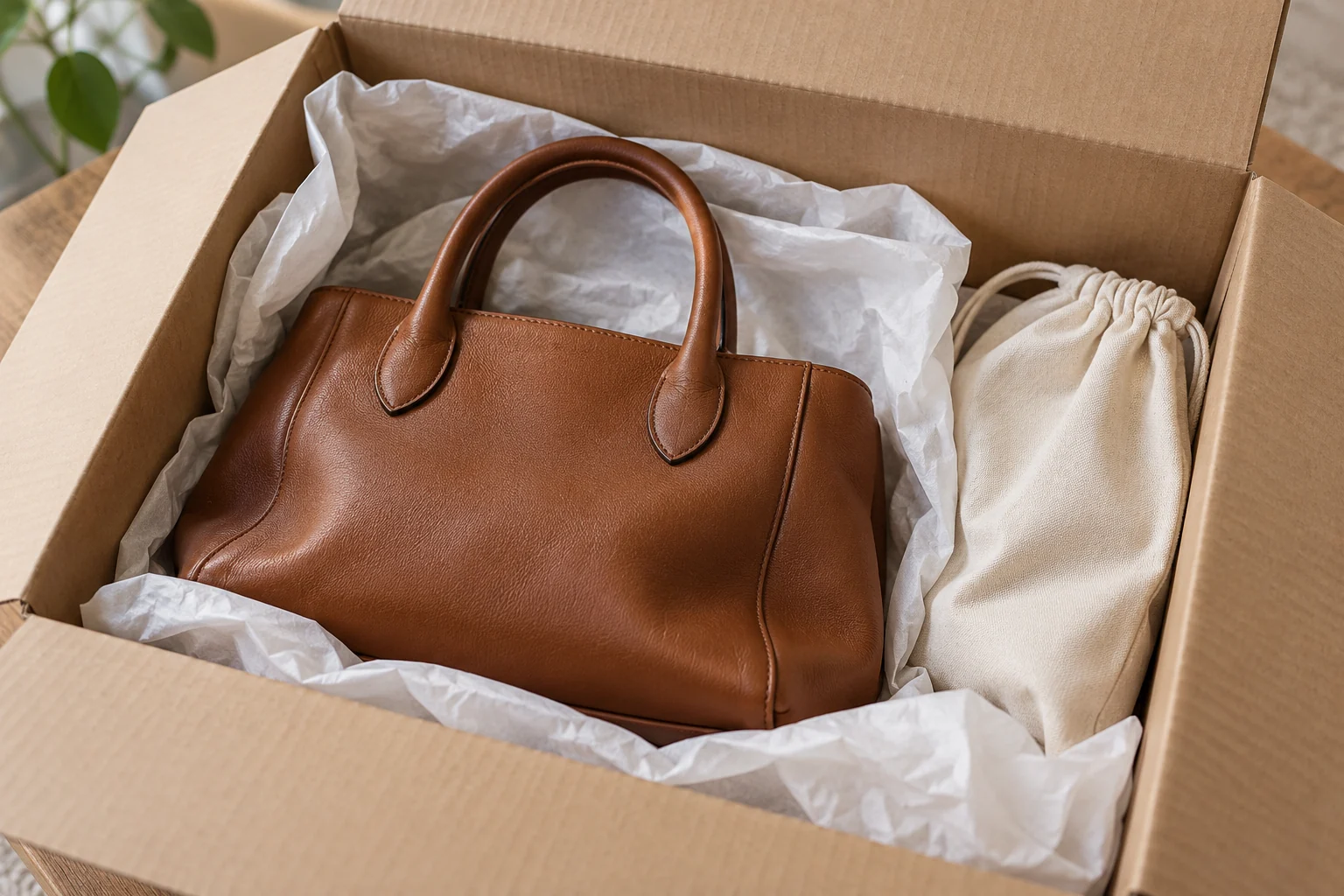
1. Separate your moving-day bag from the packed bags
First decide which bag you will keep with you on moving day. Keys and documents need to remain accessible. Give every other bag a number on your packing list and assign its accessories to the same number.
Empty all inner and outer pockets. Remove pens, cosmetics, food and loose items. Photograph the front, back, base, corners and existing damage. Note loose stitching, sticky coatings or brittle areas before continuing.
- Find the care card, model name and material information.
- Check that the original cover and any fitted supports are clean and intact.
- Discuss damaged or particularly delicate items with the manufacturer or a specialist before packing.
2. Identify the surface and construction
Smooth, coated and textured surfaces do not necessarily need the same treatment. Check the lining, trims and glued decorations too. Without instructions for your model, moving day is no reason to try a new cream, oil or waterproofing spray.
CHANEL warns that care products can alter the finish of its small leather goods. This is not a care rule for every brand: follow the instructions for your own bag.
| What to inspect | Packaging decision | Check before closing |
|---|---|---|
| Rigid, angular or cylindrical body | Allow a separate space based on external dimensions, including handles | Neither the lid nor another bag presses on its outline |
| Soft body | Use just enough soft support to hold its existing shape | No new crease or outward strain on the seams |
| Patent, suede or a delicate finish | Choose a compatible cover following the manufacturer’s guidance | No rough or colour-transferring contact surface |
| Chains, buckles and detachable straps | Keep accessories separately identified within the same packing unit | No exposed metal rests against the outside of the bag |
Product-range example from a related shop (advertisement): Leather handbags at AnkoBags — English-language shop. Its Cube and Barrel models illustrate different constructions. Base your packing list on the dimensions and materials of the bag you already own; the shop is not a source for these packing instructions.
3. Support the inside without stretching the bag
Our packing rule: preserve the bag’s existing outline. Do not flatten it or stuff it until it bulges.
Marimekko recommends a loose paper filling and a protective pouch for storing its leather bags. This can be a useful starting point for moving preparations when it matches the instructions for your model.
Add clean, soft, unprinted tissue paper in small amounts. Check the sides, base and fastening as you go. The filling should prevent collapse without putting the zip under tension. Books, shoes and charging cables are not suitable shape supports.
4. Take pressure off handles, straps and hardware
Longchamp advises placing a shoulder strap where it will not transfer colour or distort the bag. Choose a position without tension or direct pressure against the leather.
Remove detachable straps only at their intended fastenings. Label them so they stay with the right bag. Use a suitable soft separator between chains or buckles and the surface. Do not force fixed handles out of their natural position to fit beneath the box lid.
- Do not apply adhesive tape directly to leather, hardware or lining.
- Do not push a heavy accessory pouch into a small internal pocket.
- Support the body from underneath when placing the bag in its box.
5. Combine a dust cover with an outer transport box
A dust cover protects the surface but cannot keep a box of books from bearing down on it. Place the covered bag in a clean, sturdy box with enough height. Fill gaps to prevent sliding during normal carrying without squeezing the bag itself.
The Canadian Conservation Institute describes internal support and external protection for leather objects. Our moving-day application is to give delicate bags separate spaces, keep heavy items away and close the lid without force. Historic or already brittle pieces need specialist packing.
- Only share a box if each bag has its own space without pressure from the others.
- Do not use vacuum bags: compressing a bag defeats the purpose of retaining its shape.
- Mark the destination room, packing number and “do not load on top” clearly on the box.
- Agree a protected loading position with the person carrying out the move; a label alone is not enough.
6. Agree the handover and transport position
Who packs, who carries and who unpacks? Record these responsibilities if you hire help. Explain special materials and existing damage before requesting a quote. Ask the provider to confirm whether they accept the bags and under what conditions.
Plan a dry handover route and keep waiting times short. Avoid leaving the packing unit unnecessarily in a hot vehicle. Longchamp’s storage guidance recommends avoiding prolonged exposure to light, heat and humidity.
| Packing-list entry | Example to adapt | What to agree |
|---|---|---|
| Packing number and contents | B-03: one handbag, one strap in its assigned pouch | My everyday bag stays with me |
| Packaging and condition | Inner support, cover and box; existing scuff photographed | Who checks the packaging before accepting it? |
| Destination and handover | Bedroom, clear surface; no boxes placed on top | Who receives the packing unit on arrival? |
7. Open and inspect at your new home
Place the box on a clean, dry surface. Remove bags one at a time, check accessories against the packing list and inspect the same areas as before packing. Record any noticeable changes and raise them with the named company you contracted.
If a bag has become wet, do not close it back into the packaging while damp. For its leather goods, Mulberry recommends gently removing residual water and allowing natural drying with a loose paper filling. Check your manufacturer’s guidance; do not treat marks or distortions with heat or force.
If the bags will go into storage later, choose a suitable storage place separately. Do not leave the transport box in a cellar for months without checking the conditions.
8. Request packing help with a clear task list
Start with the number of bags, approximate dimensions, special surfaces, available packaging and the work you want done. Explain which items you will take yourself. Agree how to share photographs with the provider through your chosen contact channel.
Umzughilfen helps arrange introductions to independent partners. Agree packaging, materials, transport, price and dates with the specifically named company carrying out the work. An enquiry does not confirm specialist packing or availability.
Questions about moving leather handbags
Can I transport a leather handbag in a vacuum bag?
Not with this packing method: the aim is to preserve the bag’s shape. Plan space around its actual outline instead of a compressed volume.
Is the original dust cover enough?
Check the transport position as well. A cover does not replace outer protection from other belongings. Each bag needs an assigned place in the box without pressure from above.
Should I apply cream to every bag before moving?
No single treatment is suitable for every bag. Use care products only as instructed for the material and model. Have unexplained marks or damaged surfaces assessed before packing.
What does a packing provider need to know?
The number and dimensions of the bags, delicate materials, existing damage and the tasks required. Agree who supplies materials, checks the packing and receives the bags at the destination.
Sources and scope
Checked on 30 September 2026. The English-language manufacturer guidance applies to their respective products; the CCI source concerns collection objects. The packing list, handover table and boxing sequence are our editorial application to a household move, not individual care instructions.