
Paper archives during a business move
Moving a paper archive: inventory and document access
An archive becomes usable after a move when the right records are in the right place and authorised people can find them. Plan more than the number of cartons: include identification, handovers and access throughout the relocation.
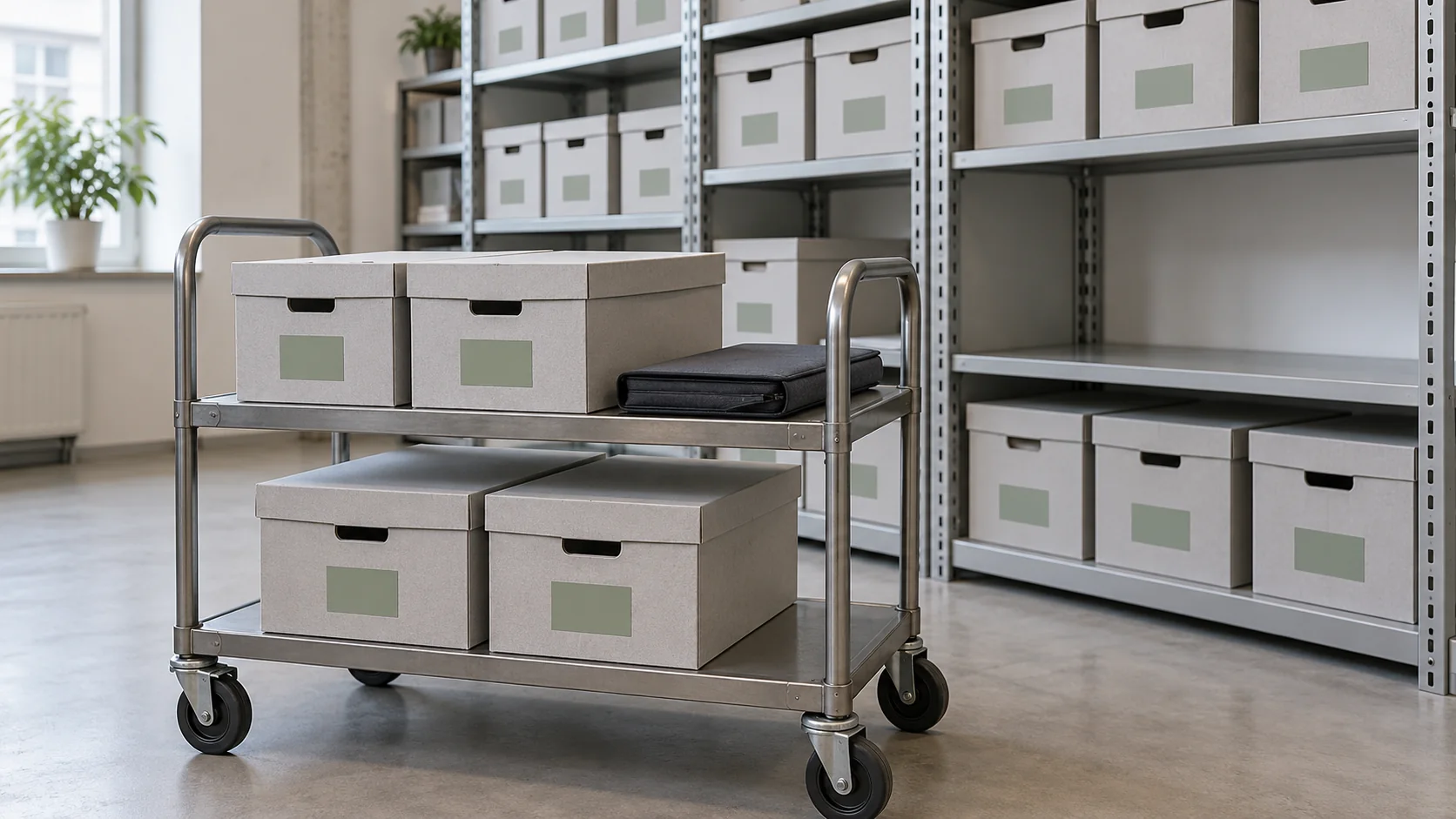
1. Define the records, responsibility and access needed
One fewer carton could mean an authorised withdrawal, a counting error or a missing unit. A traceable reference is what allows you to investigate.
This guide concerns business paper records in Germany. Start with an overview of the affected rooms, shelves and record groups. Appoint an internal records owner, a deputy and a contact for urgent document requests during the move.
Decide which records will be needed until shortly before collection or immediately after arrival. Access to individual files must be possible without opening packed boxes unnoticed or losing their order. Retention, digitisation and destruction are separate decisions; approval for transport does not authorise them.
- Identify the affected record groups and the order in which they will move.
- Agree windows for routine retrieval, packing and renewed availability.
- Record urgent withdrawals with an owner and a return route or updated storage location.
- Involve suitable specialists before packing fragile originals, unusual formats or records with concerning damage.
2. Create box IDs and a protected register
Assign unique IDs to packing units and do not reuse them. The outside needs only a neutral ID and the required destination code. Names, personnel matters, customer data and revealing file descriptions do not belong on openly visible transport labels.
Keep the contents mapping in a separate, appropriately protected register. Use existing file or collection references where needed to find records. Neutral labels do not automatically make confidential records anonymous; the mapping still needs protection.
| Field | What to record | Who needs it? |
|---|---|---|
| Box ID | A unique neutral code for exactly one packing unit | Packers, moving partner and authorised recipients |
| Contents reference | Necessary link to files or a record group in the internal register | Authorised records staff |
| Original location | Room, shelf and compartment or existing location reference | Records staff and packing owner |
| Destination | Confirmed room, shelf and compartment code at the new site | Moving partner only as required; full reference for records staff |
| Status | Open, packed, handed over, arrived or shelved; date and owner | People responsible for the relevant step |
| Discrepancy or withdrawal | Affected ID, reason, owner and investigation outcome | Authorised coordination and records staff |
4. Preserve order and use suitable packaging
Pack in sections following the existing order. Record the ID when closing a unit and check that the register and label match. If contents are split or repacked, document the new mapping; old IDs must not accidentally remain in use.
The German Archive Officers' Conference packaging recommendations consider protection, format and handling. Choose suitable inner and transport packaging for your records. An ordinary moving crate is not automatically suitable for permanent archival storage.
Agree container sizes, actual weights, permitted loads and handling equipment with the company doing the work. Records must not be crushed by closing or stacking. Have damp records or those with unusual damage assessed by appropriate specialists before normal packing.
- Fill and protect boxes so contents and order are maintained during handling.
- Place the agreed labels legibly and in a consistent position.
- Record the agreed closure and any reference it has; a closed box alone does not establish that its contents are unchanged.
- Keep special originals and formats out of the standard packing process unless suitable instructions have been agreed.
5. Record handovers by ID as well as total count
When there is a discrepancy, do not simply mark the unit as arrived. Record the affected ID, observation and person responsible for resolving it.
Before collection, agree which units belong to each transport stage and who will receive them. A total does not replace checking individual IDs. Record missing, additional or damaged units at the relevant handover point.
The preservation-focused transport recommendations published on the Bundesarchiv website call for written requirements before larger relocations. In particular, agree packaging, handling and protection during loading and unloading to suit the records.
| Handover point | What to check and record | Who confirms? |
|---|---|---|
| Packing area → collection | ID list, unit count, condition and time | Internal person handing over and appointed recipient |
| Temporary storage, if agreed | Incoming and outgoing IDs, location, period and responsible people | People authorised to receive and release units |
| Arrival at destination | Actual IDs against the dispatch list; visible discrepancies | Moving partner and named internal recipient |
| Reception → destination shelf | Each unit matched to its confirmed shelf and compartment code | Responsible records staff |
6. Prepare destination rooms and shelves before delivery
Check in advance that the planned rooms are accessible and suitable for the records. The appropriate responsible people must establish shelf layout, permitted loads and any installation requirements. Empty floor space alone does not establish a suitable archive location.
Put the agreed room, shelf and compartment codes in place before delivery. Define a controlled receiving area where unshelved boxes remain under the agreed access restrictions. Keep unresolved discrepancies distinct from units already checked.
- Align the delivery sequence with prepared destination locations.
- Keep handling and walking routes clear; do not improvise storage in general passageways.
- Update an unplanned destination change in the register only after consultation.
- Obtain specific professional advice on room and storage conditions for particularly sensitive records.
7. Reconcile units, locations and retrieval
After arrival, compare the approved departure list with IDs actually received and shelved. Include recorded withdrawals, partial shipments and later repacking. Equal totals can conceal different missing and additional boxes.
Ask an authorised person to retrieve selected records that are actually needed using the updated register. Check the contents mapping of affected units to an extent proportionate to risk. Checking box count and external condition does not automatically establish that every file is complete.
| Check | Completion criterion | If there is a discrepancy |
|---|---|---|
| Packing units | Expected and received IDs reconciled | Investigate missing, additional or duplicate IDs individually |
| Condition and closures | Observations recorded and affected units identified | Have the responsible person decide further handling |
| Destination locations | Register matches the actual shelf and compartment | Correct the location with a traceable history |
| Withdrawn records | Current location and return route known | Track the outstanding withdrawal with its owner |
| Access and retrieval | Authorised people can find the intended records | Check permissions, mapping or description as appropriate |
| Outstanding items | Owner, next step and date recorded | Close the move only to the extent explicitly confirmed |
8. Close records and describe the required service
Keep the approved register version, handover records and resolved discrepancies under your internal policy. Have old rooms checked for remaining documents before returning them. Unidentified files and storage media should not casually enter moving waste; retention or destruction decisions remain a separate process.
Umzughilfen is a marketing and referral service based in Idstein for moving enquiries in the Rhine-Main area. For an archive move, describe quantities, containers, access, destination zones and agreed handovers. Fragile originals, special access requirements or temporary storage must be assessed specifically before a commitment.
The selected independent partner confirms availability and scope. The quote, contract, work, invoice and payment are handled directly with the company named in advance. Umzughilfen remains responsible for its own referral and data-protection duties; any required specialist archival services must be expressly confirmed for the particular job.
Questions about moving a paper archive
What should be written on an archive box?
A unique neutral ID and the required destination code. File contents and sensitive names stay in a separate protected register. The ID must identify the same unit in every transport and handover list.
Can employees retrieve files during the move?
Only authorised people following the internally agreed procedure. Record the reference, person withdrawing it, time and current location or return route so the mapping is preserved.
Is counting cartons before and after the move enough?
No. Equal totals can conceal incorrect or exchanged units. Reconcile IDs, locations and recorded withdrawals; authorised owners check the contents mapping to the agreed extent.
Can any moving carton serve as a permanent archive box?
That cannot be confirmed in general. Transport packaging and permanent storage have different requirements. Agree material, format, condition and handling with the people responsible for your records.
Are scanning or document destruction automatically included?
No. The transport booking covers only the agreed services. Digitisation, retention decisions, secure destruction and specialist conservation work must be assessed separately and commissioned where needed.
Primary sources and scope
Sources checked on 18 October 2026; linked primary sources are in German. The archival recommendations are published on the Bundesarchiv website and do not replace an assessment of the actual records. The three tables and process are original editorial coordination aids for business paper archives. Specific archival laws, professional confidentiality, retention periods and conservation requirements may need separate assessment. This guide promises neither a particular security standard nor complete file contents based on a carton reconciliation alone.