
Packing & materials
How to prepare a fridge and washing machine for moving
Before either appliance is moved, establish three things: its own manual’s requirements, the transport route and who will disconnect and reconnect it. A washing machine needs different preparation from a fridge. This guide helps you assign the work in advance.
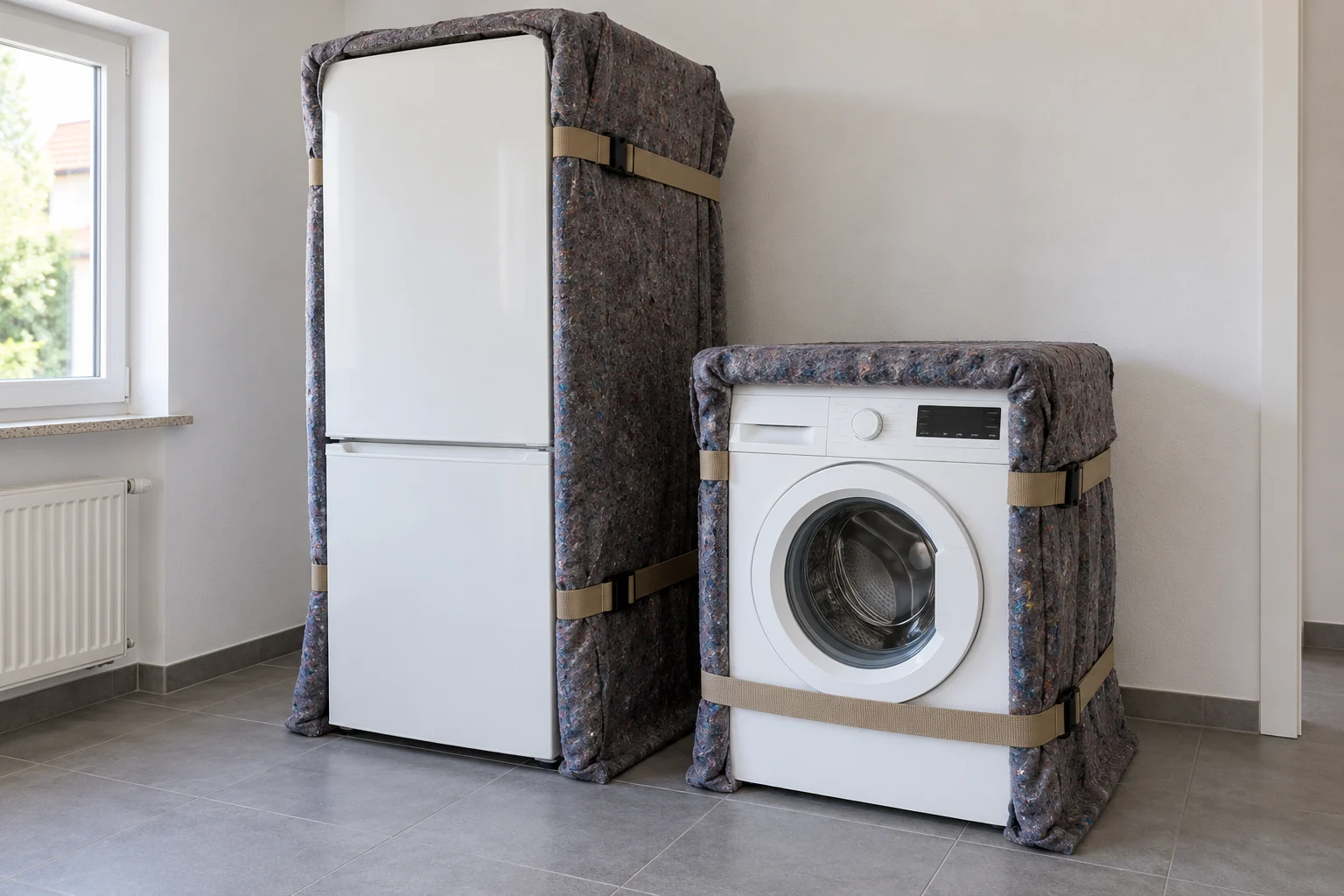
1. Create a short record for each appliance
Find the manual using the full model identifier on the rating plate. Bosch, for example, supplies documents through its E-Nr. lookup. Use the transport, installation and restarting sections for your particular version; a manual for a similar-looking appliance is not enough.
Record how the appliance is installed, its dimensions and its weight from reliable documentation. A washing machine’s laundry capacity in kilograms is not the machine’s own weight. Photograph accessible connections and existing damage only; do not pull out or tilt a connected appliance on your own just to take a photo.
| Information | Fridge / freezer | Washing machine |
|---|---|---|
| Model and installation | Freestanding, built-in or connected to a water supply? | Freestanding, built-in or below a tumble dryer? |
| Transport requirements | Permitted orientation and requirements before switching on | Correct transit restraints and fitting instructions |
| Route and space | External dimensions including handles and packaging | External dimensions, appliance weight and required handling equipment |
| Accessories | Shelves, drawers and connection accessories | Transit restraints, hoses, covers and manual |
2. Plan disconnection, removal and reconnection separately
Work on fixed electrical installations, defective connections or the refrigerant circuit is outside general moving preparation. Use an appropriately qualified specialist.
Explain whether the request covers carrying and driving only, or whether someone must disconnect the appliance, remove it from its housing and reconnect it at the destination. A transport booking does not automatically include these tasks. Arrange a suitable professional if connections, fitted furniture or a stacked washer and dryer are unclear.
Schedule preparation before the carrying team arrives. Allow the last wash to finish and cool down in good time. A seized tap, leaking connection or damaged cable is a reason to pause the process and obtain professional assistance.
| Task | Decide in advance | Result for the handover |
|---|---|---|
| Disconnect power and water | Who will do this according to the appliance manual? | Appliance ready to move; existing connections left as agreed |
| Remove from housing / unstack | What installation work is needed? | Appliance accessible and parts identified |
| Pack and carry | Who supplies materials, equipment and staff? | Route and load assessed together |
| Connect at the destination | Which person and appointment are confirmed? | Positioning, leak checks and functional checks agreed |
3. Washing machine: deal with residual water and transit restraints
An empty drum does not mean a water-free machine. Have preparation carried out using the specific manual: close the water supply, safely disconnect power, and handle residual water and hoses in the stated sequence. Water released during draining may be hot; let it cool first and collect it in a suitable container.
Check early that the complete set of model-compatible transit restraints is available. For used front-loading machines, AEG refers to refitting the original restraints. If parts are missing, ask the manufacturer to identify the correct replacements. Blankets around the casing cannot replace the internal restraints.
- Empty the drum; prepare detergent reservoirs for transport as instructed.
- Secure hoses and the power lead so they do not hang loose, kink or become trapped.
- Assign and record responsibility for fitting the restraints.
- Do not assume a universal number of bolts or fitting direction: this depends on the model.
4. Fridge: empty it, defrost if needed and dry it
Plan to use up supplies and arrange separate cooling for food before switching the appliance off. Empty it completely. Defrosting and drying must be finished by the agreed collection time; allow for the manual’s instructions and the appliance’s actual condition.
AEG warns against sharp objects when defrosting because they can damage components or the refrigerant circuit. Let ice loosen as instructed, collect meltwater and dry the interior. Do not use a knife to prise off a stubborn block of ice.
- Remove or secure loose glass shelves, inserts and drawers as instructed; cushion and label any separately packed parts.
- Agree draining and disconnection separately for a water supply or ice maker.
- Keep doors closed for transport with suitable protection; do not use handles or delicate surfaces as attachment points.
5. Assess the route, orientation and vehicle together
Measure doorways, tight turns, stair landings and the lift. Check the packed appliance’s dimensions and whether the handling equipment is suitable. Staffing depends on weight, shape, equipment and route; one fixed headcount does not fit every appliance.
Plan upright transport where the instructions require it. Liebherr recommends upright transport for its cooling appliances; AEG also recommends it for front-loading washers. Any exception or permitted side position must be established for the particular appliance. If the vehicle is too low, change the vehicle or plan rather than choosing an orientation on the spot.
Protect the casing and have a competent person plan vehicle load restraint. Washing machine transit restraints do not replace securing the appliance in the vehicle. Consider appliance weight, other belongings and vehicle limits together when planning the load.
6. Check the handover together before loading
Review the following list with the person accepting the appliance. Mark unresolved points before loading. The list organises the move; it does not replace checks of connections or technical safety.
| Check | What to record | If unresolved |
|---|---|---|
| Preparation | Empty, defrosted or drained as required by the manual | Have preparation completed |
| Restraints and accessories | Model-specific restraints checked; accessories identified | Confirm suitable parts and responsibility |
| Condition | Existing dents, scratches or faults documented | Record any differences together |
| Transport | Route, orientation, equipment and vehicle position agreed | Adjust the plan before lifting |
| Destination | Placement, connection responsibility and manual available | Agree the appointment or position |
7. Arrival: positioning is not the same as starting the appliance
Inspect the condition after unpacking and account for all parts. Washing machine transit restraints must be removed as instructed before operation. Have positioning, levelling, connections and watertightness checked, then carry out the prescribed initial functional check.
There is no universal waiting time for fridges: current guidance from AEG and Liebherr differs. Your version’s manual and the actual transport orientation determine the requirements. If the transport position or the time at which switching on is permitted is unclear, ask the manufacturer first.
Permission to switch on does not mean the interior has reached the temperature required for food. Plan putting food back separately. If there is visible damage, a leak or unusual behaviour, stop operation where safe and contact a specialist.
8. Send a complete transport enquiry
Provide both addresses, preferred date, floors, lift details and carrying routes, plus each appliance’s model, dimensions and weight. Add preparation, packaging, installation status and any connection work required. Share photos only through a previously agreed contact channel.
Umzughilfen introduces independent partners. The specifically named company confirms services, price and dates and is your contracting party for its work. Ask it to confirm acceptance and the agreed handling of the appliances; an enquiry alone does not secure a connection service or particular transport arrangement.
Questions about preparing appliances
Can the washing machine be moved without its transit restraints?
Missing required restraints remain an unresolved preparation issue. Before loading, use the model number to confirm suitable replacement parts with the manufacturer. An outer blanket does not solve this problem.
Can I lay the fridge and washing machine on the same side?
Do not transfer an orientation recommendation from one appliance to another. Check each manual and agree the permitted position with the provider carrying out the work.
Must every fridge wait the same time after a move?
No. Confirm the requirements for your model and the actual transport orientation. Do not use one standard number of hours for every appliance.
Is reconnection included in the transport price?
That depends on the services expressly agreed. List disconnection, removal, packing, carrying, transport and reconnection separately and have the scope confirmed.
Which weight does the transport provider need?
The appliance weight from documentation for the particular version. Laundry capacity or a fridge’s usable volume is not its transport weight.
Sources and scope
Checked on 30 September 2026. German-language manufacturer information; the Bosch PDF illustrates a model-specific manual and is not an instruction for all washing machines. Use the appropriate documentation for your appliance. The appliance records and handover tables are editorial planning aids.
- Bosch: find the correct manual by model number (German)
- AEG: transporting front-loading washers and washer-dryers (German)
- Bosch: example manual, transport and restarting (document 9000680041_C, German PDF)
- AEG: defrosting a fridge-freezer or freezer (German)
- AEG: transporting a fridge and checks before switching on (German)
- Liebherr: transport, installation and initial operation FAQ (German)
- Bosch: delivery and connection terms as an example of separate services (German)