
Plan the team and divide the work
How many moving helpers do I need?
Start by counting the roles that need to be covered at the same time. Two people carrying and another preparing the next items would mean three people in total. Whether that arrangement suits your move depends on the items, access, equipment and people available. The number of rooms alone cannot give you a reliable headcount.
1. Start with the inventory and access routes
Adding helpers does not by itself make a piano, safe or awkward heavy piece of furniture suitable for a DIY move. Have the specific transport task and equipment requirements assessed by a competent professional.
Before requesting helpers, list what actually needs to be moved. Flag bulky, heavy, fragile or unprepared items. Record dimensions and weights you know; explicitly mark unknown values. Box counts and estimated volume describe the workload but do not replace an assessment of individual items and access routes.
BG Verkehr considers factors including loads, posture, repetition, duration and recovery when assessing physical strain. Our planning conclusion is that a fixed number of helpers per room is not a sufficient basis for organising the work.
| Check | Confirm at both addresses | What it means for the team |
|---|---|---|
| Inventory | Boxes, large items, dimensions and readiness | Separate carrying, preparation and special tasks |
| Stairs and doors | Floors, narrow sections, landings and door openings | Extra people do not automatically create more space |
| Lift | Usable dimensions, load capacity and actual availability | Plan which items can use it and allow for waiting |
| Carrying route | The route from the room to an available loading space | Coordinate staging, carrying and work at the vehicle |
| Additional work | Packing, dismantling, assembly and extra stops | Assign suitable people and separate time slots |
2. Assign roles before counting people
Three people on site and three booked helpers mean different things. Specify who comes from your household, who helps privately and who is supplied by a provider.
Give each task a named person, a location and a time slot. One person can handle several roles in sequence. They cannot prepare items in the old home and receive them at the destination at the same time. Include travel, breaks and the change between addresses.
Count yourself only for work you can actually do. Someone looking after a child, collecting the vehicle or completing a property handover is not available to carry items during that period.
| Role | Specific work | Agree beforehand |
|---|---|---|
| Preparation | Stage packed, labelled items in the agreed order | Keep staging areas usable and access routes clear |
| Carrying | Move the assessed items along the agreed route | Suitability, coordination and appropriate equipment |
| Vehicle work | Handle loading and securing the load | Named responsibility, knowledge and equipment |
| Driving | Collect, drive and, if applicable, return the vehicle | Count as additional help only when expressly agreed and possible within the schedule |
| Receiving | Open the destination and identify the right rooms | Keys, contact details and arrival time |
| Coordination | Agree the sequence, answer questions and manage interruptions | One named contact and a stop signal everyone understands |
3. Examples for two, three and four people
In the three-person example, booking two helpers could work if you can reliably cover the third role and the provider confirms the arrangement. If you cannot, that role still needs someone.
These examples illustrate task allocation at one address only. They assume an assessed carrying task for which the two people involved and their equipment are suitable. Packing and any necessary dismantling are complete. The vehicle, driving and support at the other end are planned separately.
The figures count everyone working at the same time, including participating household members. They are not recommendations for a particular home size, proof that an item can be carried safely or predictions of how long a move takes.
| Total team in the example | Possible allocation | What follows |
|---|---|---|
| 2 people | Both do the assessed carrying task; preparation and vehicle work happen in sequence | While both are carrying, no additional person is free for questions or loading |
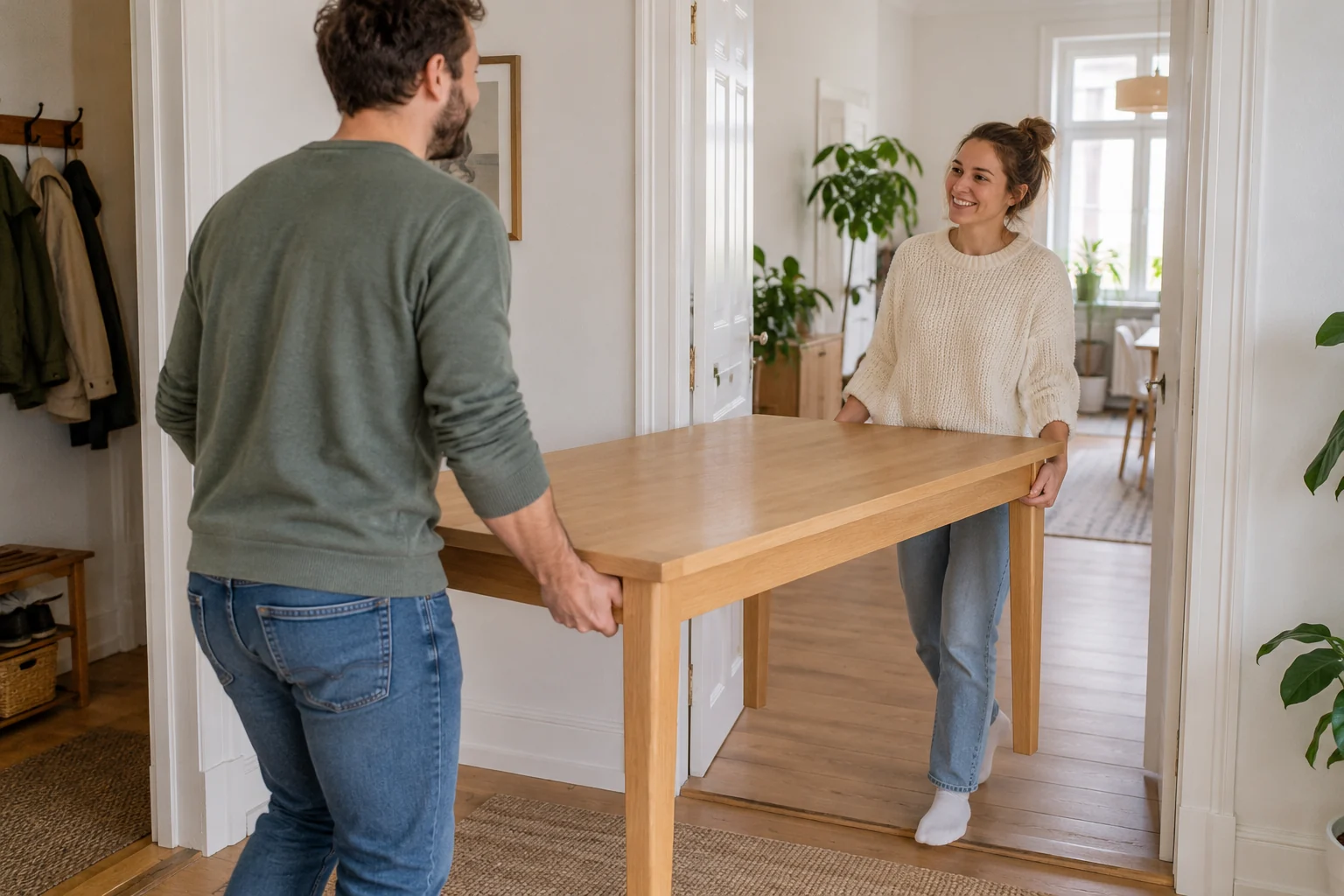
| 3 people | Two carry; the third prepares items and coordinates the next task | The third person is not simultaneously available at the other address |
| 4 people | Two carry, one prepares items and one handles the agreed vehicle work | Parallel work helps only if access, staging space and tasks allow it |
4. Agree locations, time windows and charging
Do you need loading only, unloading only or help at both addresses? Say so explicitly. Confirm whether the same team travels, how helpers get to the destination and whether waiting or travel time is charged. A helpers-only job does not automatically include a van or driver.
Verbraucherzentrale recommends discussing individual moving services and recording them in writing. Ask for the tasks, headcount and charging basis to be confirmed in your specific offer.
Three people working two hours each add up to six person-hours. This does not mean four people could complete the same work in an hour and a half. Narrow passages, lift journeys and dependent tasks limit how much can happen at once.
- Date, start window, both addresses and anticipated scope.
- Number of people and their roles; your own contribution and excluded work.
- Who supplies tools, protective material and suitable moving equipment.
- Rate per person or for the entire team, minimum booking and billing increments.
- Arrangements for breaks, travel to the job, travel between addresses, waiting and extensions.
- A named contact and a procedure for cancellations or changed conditions.
5. Walk through the plan before starting
Check the routes and sequence together before moving the first item. Agree what will be needed first and where items can stand without blocking access. Use clear instructions and a stop signal everyone understands.
For pushing and pulling, BG Verkehr highlights clear visibility, intact transport equipment and loads that can be moved and stopped under control. Having a sack truck does not establish that it suits every item and route.
If furniture is not dismantled as described, the lift is unavailable or access is narrower than expected, pause the affected task. Review the plan and agree changes with the provider. Do not try to resolve an unassessed situation by adding people on a narrow staircase.
- Confirm tasks, sequence, responsibilities and available equipment.
- Plan breaks and an accessible point of contact.
- Do not pressure someone into a task they do not feel able to do.
- If a helper cancels, identify the exact role left uncovered before starting.
6. Send an enquiry that explains the division of work
Example opening: “We will provide the vehicle and driver. We need help with loading and unloading. I will coordinate but will not carry items. Please use the attached information to assess the team and equipment required.”
A useful enquiry describes the job and asks the provider to confirm a suitable team size. Final staffing should not rest solely on a headcount found online. Pass on new information or changes before the appointment.
- Timing: date, preferred start window and any necessary time limits.
- Locations: start and destination, floors, lifts, stairs and carrying routes at both addresses.
- Inventory: list, known dimensions and weights, special items and outstanding questions.
- Preparation: what is packed or dismantled, and what extra work is needed?
- Your contribution: vehicle and driver arranged? Who will help, when and with which tasks?
- Requested help: loading, unloading or both; please confirm team size, equipment, scope and charging.
7. Confirm the help with the named partner
Umzughilfen is a marketing and referral service. A named independent partner issues its own offer and contracts directly with you. That partner carries out the work, invoices you and receives payment. Umzughilfen remains responsible for its own referral and data protection duties.
You receive the partner's name and address before a binding booking. Have the team, tasks, date and equipment confirmed. An enquiry alone does not reserve helpers or a vehicle and does not confirm a particular moving duration.
Questions about the number of helpers
Are two moving helpers enough?
That requires an assessment of the actual job. Check the items, access, equipment and every other role. Two booked helpers plus your confirmed contribution is a different plan from two people in total. The examples are not a blanket recommendation for carrying items.
Does the driver count as a moving helper?
Only if their help is expressly agreed and fits around driving, collecting the vehicle and other duties. A driver is not automatically booked as an extra person to carry items.
Can I book helpers only for unloading?
You can request that limited service; the provider must confirm whether it offers it. Describe the inventory, access, arrival window and tasks, and clarify the minimum booking and any waiting charges. Work at the starting address still needs separate arrangements.
Will twice as many helpers halve the moving time?
No. Additional people help only when suitable tasks can run in parallel. Narrow routes, a shared lift, preparation and driving cannot be split indefinitely. Any duration estimate needs to reflect the actual sequence of work.
Sources and scope
Sources checked on 28 September 2026. Roles, checklists and numerical examples are original editorial planning aids. The BG Verkehr sources address physical strain at work; they do not specify a number of helpers per home. These examples do not replace assessment of the actual transport job.