
Planning wall art after a move
Choose picture sizes for your new home
A picture that suited your old sofa may look too small or too large on the new wall. Start with the final furniture position and the usable wall area. Work with the outer dimensions of the frames, then test the arrangement with paper templates before ordering anything or arranging installation.
1. Record the pictures you already own
For each picture, note its outer width, outer height, orientation and weight including the frame and glazing. A poster’s dimensions do not necessarily describe its framed footprint: a frame and mount can increase the size. Check what a new product’s measurements actually refer to.
Keep packed pictures protected until the furniture position and display area are settled. Smaller existing pictures may work together as a group; moving home does not automatically mean buying new wall art.
- Collect photos and dimensions of existing pictures.
- Place the sofa, bed or sideboard in its intended position where possible.
2. Measure the area you can actually use
Measure the space between doors, windows, lamps and other boundaries. Above furniture, also record the furniture’s width and position. The wall and the furniture may have different centre lines; decide which one will anchor the arrangement.
| Measurement or condition | What to record | Why it matters |
|---|---|---|
| Usable wall area | Width and height of the available area. | Outer limits of the arrangement. |
| Furniture | Width and actual position. | Reference point for the composition. |
| Frame or canvas | Outer width and height of each piece. | Size of the paper templates. |
| Surroundings | Doors, switches, lamps, walkways and use. | Obstacles and clearances to consider. |
3. Calculate a single picture and a group separately
Use the outer dimensions. A composition may also be wider than the furniture if the wall area and everyday use support that choice.
A row’s total width equals the sum of all outer widths plus the gaps. For equally sized pictures: number × outer width + (number − 1) × gap. For several rows, calculate the overall height and vertical gaps too.
Example: a sofa is 180 cm wide. The table compares three chosen layouts. The space on each side applies only when the arrangement is centred above this sofa. These figures are examples, not minimum clearances or a universal design rule.
| Arrangement | Overall width | Space per side above 180 cm |
|---|---|---|
| One frame, 90 cm wide | 90 cm | 45 cm |
| Two 60 cm frames with a 10 cm gap | 60 + 10 + 60 = 130 cm | 25 cm |
| Three 40 cm frames with two 8 cm gaps | 3 × 40 + 2 × 8 = 136 cm | 22 cm |
4. Test the effect with paper templates
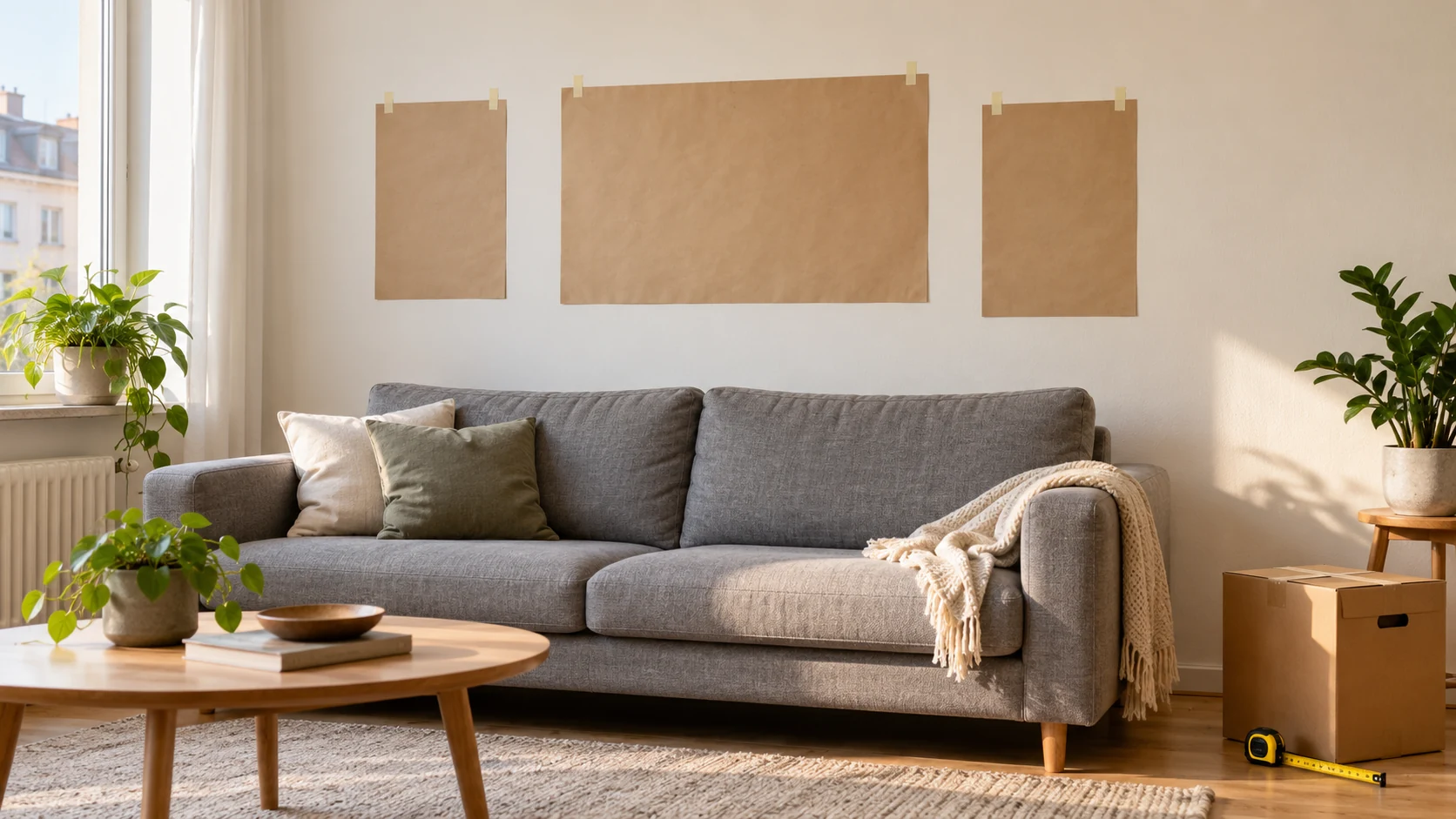
Cut a template for each frame using its actual outer dimensions. Arrange the pieces on the floor first, then transfer your chosen layout to the wall. Use only temporary attachment suitable for the surface and tested in an inconspicuous area. For a delicate wall finish, use a scaled sketch or floor layout instead.
View the arrangement from the entrance and your usual seat. Open doors and check whether furniture, lights or routes interfere. Photograph two options from the same viewpoint before deciding.
- Include the outer dimensions and planned gaps.
- Check the height both seated and standing.
- Remove templates; a size trial does not determine drilling positions.
5. Distinguish format, frame and order details
A portrait picture, a landscape picture and a multi-panel composition can feel very different at a similar overall width. For sets, check whether the stated size describes one panel, the sum of panels or the complete arrangement including gaps.
Order after the trial. Check the selected variant, unit of measurement, number of pieces, supplied components and any frame you need to buy separately. A product visualisation cannot replace measuring your wall.
Advertisement for a related project: the CetArt sizing guide is in English and shows canvas formats and multi-panel sets. CetArt is a related poster and canvas-print shop, rather than an independent recommendation or a picture-transport service. Use the illustrations for orientation; check the selected product variant for the applicable specifications.
6. Check the display location and installation
For sensitive originals, preservation matters more than an apparently empty wall. The Canadian Conservation Institute recommends keeping artwork away from radiators and air vents; direct sunlight can also heat the surface. Seek specialist advice for valuable or delicate works.
The paper trial does not select a fixing. Installation requires information about wall construction, total weight, hanging hardware and possible hidden services. Give the installer these details and the intended arrangement.
7. Turn the decision into a short installation brief
Keep a photo and dimensioned sketch of the selected arrangement. This avoids repeating decisions when several people coordinate furniture, pictures and deliveries after the move.
| Prepare | Record | Still to confirm |
|---|---|---|
| Picture or set | Outer dimensions, quantity, weight and photo. | The actual supplied components. |
| Position | Reference point and horizontal/vertical gaps. | Final furniture position. |
| Installation | Wall details and requested work. | Suitable fixing and appointment with the installer. |
Questions about picture sizes after moving
How wide should a picture above a sofa be?
This plan does not impose a fixed ratio. Measure the sofa and usable wall, calculate the outer width and compare templates from your normal viewing positions.
Should I use the poster size or frame size?
Use the finished picture’s outer dimensions to plan the space. A poster with a mount and frame may be substantially larger; check the actual configuration.
How do I calculate the width of multi-panel artwork?
Add all panel outer widths and the planned gaps. Check whether the product’s stated overall measurements already include the gaps.
Can I reuse small pictures from my old home?
Yes. Test a group with shared alignment points or a smaller wall area. Plan with existing pictures first, then choose any missing formats.
Is installation included in a moving enquiry?
Only if the identified service partner expressly offers and agrees it. Planning, transport and wall installation are separate services to confirm.
Source and context
Checked on 12 October 2026: CCI guidance on the environment for paintings. The measuring plan, worked examples and paper trial are editorial planning tools. CetArt is a labelled related product example; its linked sizing guide is in English.