
Different surfaces need different protection
How to pack pictures, posters and mirrors for a move
A framed print, a painted canvas and a mirror are different packing jobs. The surface, construction, condition and route determine the approach. Identify each item first, then agree the protective materials, outer packaging and handling. Valuable originals and particularly fragile items need an individual professional assessment before packing.
1. Identify the material and condition first
A low purchase price does not make a delicate surface robust. A high declared value does not replace a description of the actual condition either.
Review the items before buying supplies. Note whether they are glazed, whether the picture is secure in its frame and whether original packaging with the correct inserts is available. Keep an unidentified surface marked as unknown in your list.
The table helps identify the next planning task. Classification alone does not establish fitness for transport or show that a box you already own is suitable.
| Item | What to establish first | Next planning task |
|---|---|---|
| Framed print behind glass | Glazing type, frame condition and secure fit | Select a suitable picture package |
| Loose paper poster | Printing process, coating, previously flat or rolled | Choose a flat folder or an approved tube solution |
| Painted canvas | Surface condition, stretcher and any protective travel frame | Have packaging that avoids surface contact assessed |
| Mirror or loose glass panel | Dimensions, weight, edges and fixings | Agree removal, support and restraint beforehand |
| Original, antique frame or damaged item | Individual value, material and existing damage | Involve a conservator or specialist transporter |
2. Record condition, dimensions and responsibilities before removal
Give each item an ID. Photograph the overall view, accessible back, corners and visible existing damage without moving it unsafely just to obtain a photo. Record outside dimensions including the frame and any known weight; mark estimates clearly.
The Canadian Conservation Institute recommends checking the painting and frame, clearing the route and preparing a resting place before moving it. Flaking paint or an unstable frame calls for professional stabilisation first.
- Record the ID, destination room and contact for questions.
- Assign wall removal, packing, carrying and later installation separately.
- Check narrow points and clearance for the packed dimensions at both addresses.
- Keep personal documents and uninvolved people out of photos.
- Never carry a picture by its hanging wire or just one upper frame member.
3. Pack sound glazed picture frames
Pack each item individually. A fragile label supplements the packaging; it cannot perform its protective functions.
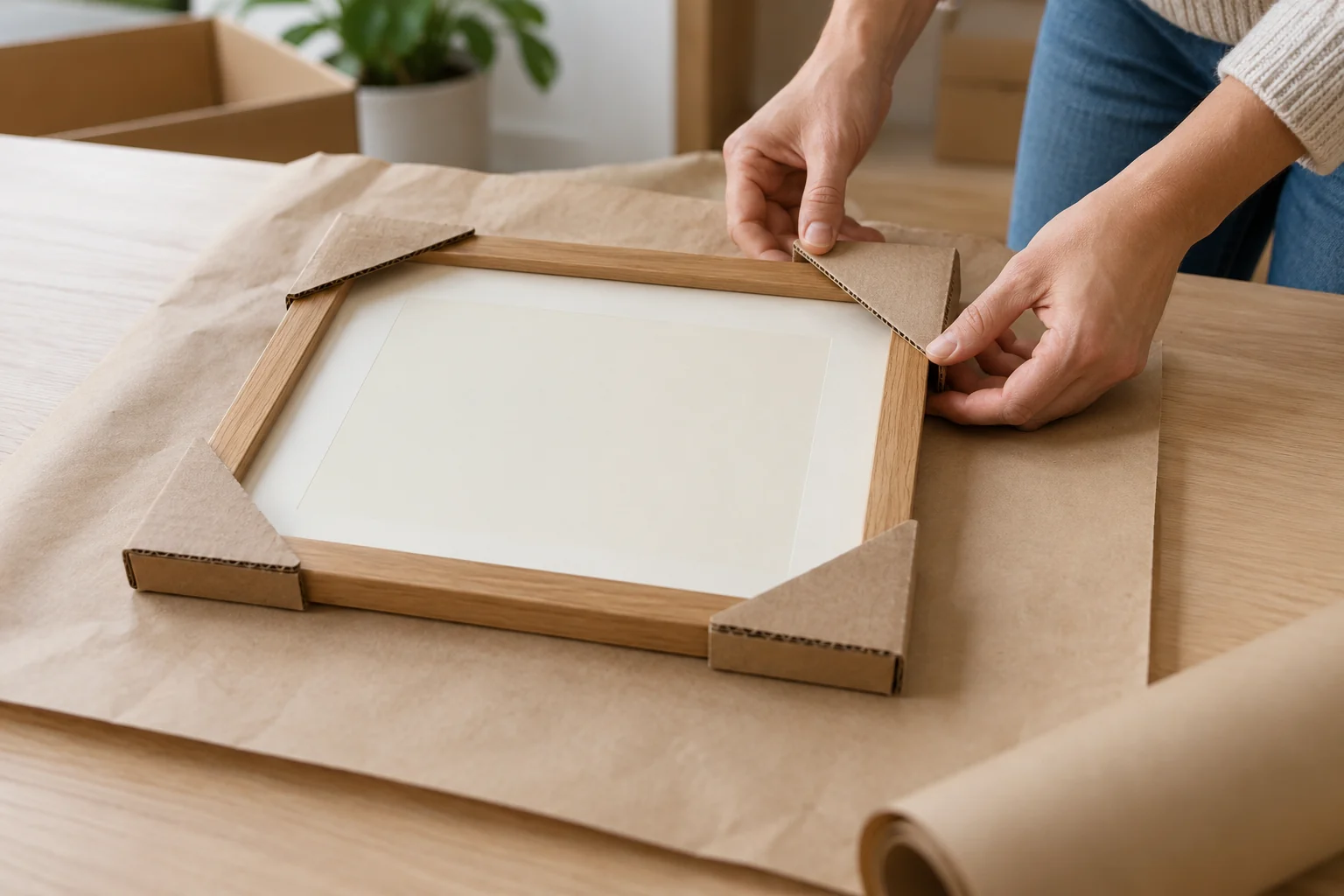
For a stable, undamaged everyday frame, a suitable picture package with its intended inserts is a useful starting point. Check its instructions and size range against the actual item. A similar empty carton without its inserts is not the same packaging system.
Protection should bear on the sound frame or the packaging structure intended for that purpose. A rigid front cover must not sag onto the image surface. Tape belongs on the packaging, not the picture or frame. If you cannot establish secure support and clearance, have a professional pack it.
Do not automatically put a tape cross on unidentified glazing. Coated glass, laminated glass and acrylic have different manufacturer instructions. Tru Vue, for example, identifies glazing that needs no additional protective film for shipping. A film you choose yourself is therefore not a universal solution.
- Prepare the matching carton and inserts according to their instructions without the picture present; then remove cutting tools from the work surface.
- Fit the intended corner protectors only at suitable, sound points on the frame. Do not clamp fragile decoration.
- Fit the intended front and rear covers and check clearance from the vulnerable surface.
- Support the prepared unit in the outer packaging with the matching cushioning. Close it without applying pressure to the glazing or picture.
| Packaging function | Check before closing |
|---|---|
| Protect surfaces and corners | Compatible materials and suitable contact points; no pressure on delicate decoration |
| Maintain clearance and support | No free movement, hard contact between items or load on the glazing |
| Provide a sound outer container | Box dimensions, room for suitable cushioning, condition and closure according to its instructions |
4. Protect paper posters flat or use a suitable tube
A suitable folder and rigid support help protect flat paper works from creasing. Pastel, charcoal and other easily disturbed surfaces need protection without direct material contact. CCI’s paper guidance specifically distinguishes these fragile media.
Do not tightly roll a previously flat poster just because a small tube is available. Ask the manufacturer or framer whether that exact print can be rolled and which direction, interleaving and diameter are suitable. Already rolled, undamaged everyday prints may be able to travel in their matching original packaging. Do not force an unknown or brittle print flat or roll it again.
- Choose a folder that contains the edges without placing pressure on the image.
- Check an approved tube package for a clean interior, suitable dimensions, clearance from end caps and a secure closure.
- Label the outside; do not secure the paper with rubber bands, paper clips or adhesive strips.
5. Keep packaging clear of painted canvas
Plan to keep a stretched canvas on its stretcher. Do not remove it to fit a smaller box, roll it, retension it or work on the paint layer yourself. Any necessary alteration belongs with an appropriate professional.
Bubble wrap is not a direct contact layer for a painted surface. Do not place paper against paint or varnish without checking suitability either. A suitable travel frame may be needed to keep wrapping clear; CCI describes these frames for protecting vulnerable paintings.
Arrange an assessment of an original by a conservator or art transporter before packing. Ask about support, surface protection, packaging and conditions during the journey. Mention whether it was recently painted, is already damaged or has been restored. Appearance alone cannot establish a drying time.
6. Plan mirrors and loose glass panels separately
If you find a crack or loose glass edge, stop ordinary packing, keep the area clear and seek professional advice on handling it. Do not test it by pressing, bending or shaking.
For a small, sound mirror in a stable frame, check the front, back and edges and select packaging suited to it. AGC’s Mirox guide identifies mechanical damage and moisture as packaging risks and specifies vertical placement for processed mirror sheets. These are product-specific instructions, not a complete method for every household mirror.
Large, heavy, frameless, bonded or damaged mirrors and loose glass tabletops need advance planning with a suitable specialist. Have removal, edge protection, a transport rack, handling equipment and restraint specified. A mirror loosely leaning against the van wall is not secured for transport; straps pressing across the glass do not replace a suitable support system.
If the mirror belongs to a wardrobe or door, establish the removal method from the particular furniture construction. Do not release wall adhesives, unidentified fixings or electrical connections on illuminated mirrors as an improvised packing task.
7. Label packages and prepare for arrival
Inspect packages before opening. If damage is visible, photograph the condition and packaging and contact the partner carrying out the work promptly. Only record what was actually checked; retain packaging for clarification where it is safe to do so.
Mark the outer packaging with the item ID, destination room and agreed orientation. Only include instructions that match the actual package. Arrange suitable secured space in the vehicle, without heavy cargo bearing on fragile packages. Have the team carrying out the move check the specific load restraint.
Avoid unnecessary waiting in rain, direct sun or unsuitable rooms. CCI notes that cold paintings entering warm, humid spaces can develop condensation. For sensitive works, agree how temperature changes and unpacking will be managed individually instead of assuming a universal waiting period.
| List entry | What to record |
|---|---|
| Package ID | Link to the inventory and condition photos |
| Packaging | Who packed it, when and using which agreed solution? |
| Handover | Date, people involved and visible outer-package condition |
| Destination | Room, prepared resting place and responsible person |
| Unpacking | Agreed timing, visible differences and photos |
8. Request a specific packing service
State the number of items, materials, dimensions including frames, known weights, condition and requested tasks. Identify originals, special glazing and large individual pieces explicitly. Agree whether on-site packing, specialist materials, removal, transport and later installation can be offered. A description such as a few pictures is not enough for this.
Send photos only through a channel agreed with the named contact. The Umzughilfen enquiry form has no photo upload. Images should show condition and the task; identity documents, private letters or a publicly accessible home album are unnecessary.
Umzughilfen is a marketing and referral service. A named independent partner prepares its own quote and contracts directly with you. It performs the agreed work, issues the invoice and receives payment. Umzughilfen retains its own referral and data-protection duties. You receive the partner’s name and address before a binding booking.
An enquiry does not confirm specialist packaging or reserve a date. Have the partner confirm suitability, scope, price and the conditions offered for your items.
Frequently asked questions about packing pictures and mirrors
Should I put a tape cross on the glass?
Not as a general rule. Glazing and coatings can require different treatment. Check protective film with the manufacturer or a specialist. A tape cross replaces neither suitable packaging nor restraint in the vehicle.
Can bubble wrap touch the canvas directly?
Packaging for a painted canvas should avoid direct contact with the paint layer. Have a suitable solution selected that maintains clearance from the surface; particularly vulnerable works may need a travel frame.
Can every poster travel in a tube?
No. Whether rolling is suitable depends on the paper, printing, coating and condition. Do not roll a previously flat or unidentified print on guesswork. Agree packaging for valuable paper works with a professional.
Is a moving box enough for a large glass panel?
The box alone cannot establish that. Dimensions, weight, edges, support and restraint need to work together. Describe large or loose glass panels to a suitable specialist beforehand and agree the entire handling process.
What should a picture-transport enquiry include?
Quantity, material, frame, dimensions, known weight, condition, access and requested work. Identify valuable or delicate items individually and establish who packs, carries and unpacks them. The enquiry itself is not a booking.
Sources and context
English-language sources checked on 29 September 2026. CCI guidance concerns cultural heritage conservation; AGC and Tru Vue describe specific products. FedEx explains general packaging functions for parcel shipping. Their product, contract and insurance conditions are not automatically transferable to a move. The tables and workflow are original planning aids, not an object assessment.
- CCI: inspecting and handling paintings
- CCI: wrapping paintings with surface clearance
- Tru Vue: product-specific care for glass and acrylic
- FedEx: outer boxes, cushioning and restricting movement
- CCI: paper objects and fragile drawing media
- CCI: protecting paintings and using travel frames
- AGC Mirox: packaging guidance, version 3.0 (2018)
- CCI: temperature changes and condensation in paintings