
Check the furniture and its route together
Dismantle furniture before moving or transport it assembled?
Not every piece of furniture needs to come apart for a move. The question is whether it can be handled safely in its current condition along the entire route at both addresses. Check dimensions, construction and access first. Then decide which parts need removing and who will put them back together.
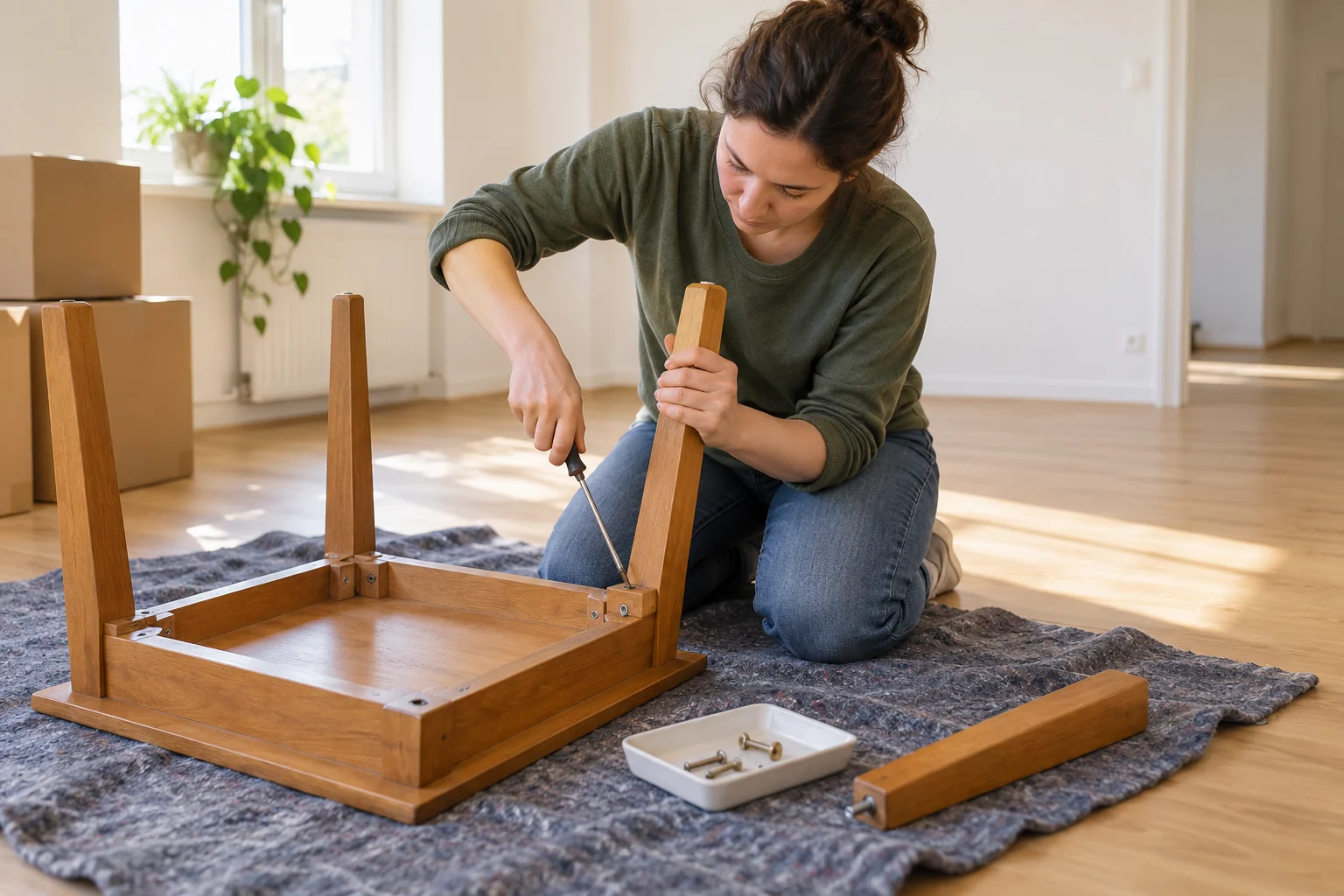
1. Four options instead of a blanket rule
Keep an unanswered question marked as unresolved. Assuming that an item will fit does not provide a sound basis for choosing the vehicle, team or assembly work.
Give each large item its own entry in your inventory. A compact, sound cabinet may need a different approach from a tall unit with loose joints. Labels such as solid wood or flat-pack furniture do not settle the question on their own.
The table below helps organise the options. It is a planning aid, not approval to lift an item. Even furniture that fits through a doorway needs suitable handling, protection and restraint in the vehicle.
| Option | When to consider it | What to establish first |
|---|---|---|
| Move assembled | Sound construction; sufficient space along the full route; handling assessed | Transport dimensions, weight, grip points and loose parts |
| Partly dismantle | Individual components designed for removal obstruct the move | Which parts the correct instructions allow you to remove and whether the remainder stays stable |
| Dismantle following instructions | The route or construction calls for more extensive disassembly | Exact model, dismantling procedure, condition and space for reassembly |
| Get a professional assessment | Unknown joints, damage, heavy special items or delicate mechanisms | Inspection, suitable equipment and the person qualified for the task |
2. Measure the whole route at both addresses
Door width and furniture width do not prove that a turn is possible. A calculated diagonal cannot establish the full movement through three-dimensional space either. If clearance is tight or uncertain, provide photos and measurements and arrange an assessment instead of trying to force the item through.
Record width, depth and height in the intended transport configuration, including protruding parts and protective packaging. Mark whether each figure was measured, taken from product documentation or estimated. An estimate must not silently become a confirmed measurement.
Follow the route from the current position to the final position in the new home. A wide front door is little help if a tight stair turn comes next. Door leaves, handrails, low ceilings and fixed fittings can reduce the available space.
| Check | What to record |
|---|---|
| Furniture | ID, model, width × depth × height, known weight, transport configuration and packaging |
| Doors and passages | Actual clear opening; projections and space on either side |
| Hall and stairs | Narrow points, landing, turns, headroom and handrail |
| Lift | Clear doorway, cabin dimensions, permitted load and actual availability |
| Vehicle | Loading opening, floor space and suitable load-restraint options |
| Destination room | Final position, working space and ceiling height needed for the specified assembly method |
3. Check the model, joints and condition
Find documentation for the exact model and version. IKEA, for example, provides assembly instructions on its current product pages. The PAX frame 904.582.02 also has a separate dismantling guide. This does not establish one disassembly method for every wardrobe or older version.
Assembly instructions are not automatically safe dismantling instructions in reverse. Ask the manufacturer or an assembly professional which connections can be released and which parts need supporting while that happens. Do not force glued or unidentified joints apart.
Photograph existing damage and mention earlier repairs. Broken fixing holes, loose fittings, swollen panels or a distorted frame need assessment before transport. Glass and mirrored doors, stone slabs, spring or lifting mechanisms and electrically adjustable furniture also need an appropriate method agreed separately.
- Identify the manufacturer, model and article number where available.
- Keep the correct assembly and any dismantling instructions.
- Document joints, back panel, feet, moving parts and existing damage.
- Have uncertain structural strength or mechanisms assessed before work starts.
4. Identify parts and fittings before dismantling
Keep fittings from different items separate. Put labels on suitable protective wrapping; do not apply tape directly to a delicate finish without checking compatibility. Carry the bags together in a labelled box and record where it is.
Photograph the item and accessible connections before the planned disassembly. Use an overall image to show position and a close-up to show the connection. Record orientation too: front, back, left and right. Keep personal documents and uninvolved people out of the images.
Assign each item an ID and use it for photos, the parts list and fitting bags. The following labels are an invented organisation example. They do not identify which components may be removed from your particular model.
| Example ID | Meaning | Matching record |
|---|---|---|
| M01 | Complete item | Overview, model and destination room |
| M01-01 | A component approved for removal | Photo of its original position and orientation |
| M01-B1 | Fitting bag for a documented work step | Parts list with quantities and the relevant photo |
| M01-open | Unresolved connection or missing part | Description and agreed follow-up question |
5. Maintain stability through to reassembly
The team and equipment must suit the furniture, weight and route. Extra hands alone cannot resolve unstable construction or unsuitable access.
Empty the furniture before preparing it. Whether doors, shelves or drawers should be removed or secured in place depends on the construction and agreed transport method. A partly loosened frame is not ready for transport. Do not leave it unsupported or ask helpers to improvise carrying it.
Release an anti-tip fixing only after establishing support and the next steps. Restore required wall anchoring before use at the destination. Choose fixings suited to that wall and get professional advice if unsure.
Agree who will check the parts inventory, connections, stability and required restraints at the destination. Missing fittings or damaged joints must be resolved before the furniture is used. Work involving electricity, gas or water connections should be arranged separately with an appropriate professional.
6. Agree dismantling, transport and assembly separately
For each item, describe the intended condition at collection and after assembly. Furniture transport does not by itself specify whether dismantling, packing, reassembly or wall anchoring is included. Ask for the relevant tasks and exclusions to be listed in the quote.
Compare the complete process. Removing fewer parts may save assembly work but place different demands on handling and the vehicle. Extensive dismantling creates smaller pieces but requires preparation, packing and reassembly. Neither option guarantees a saving without knowing the inventory and access.
- Who will decide the transport configuration from the instructions and measurements?
- Who will empty, dismantle, label and pack each item?
- Who supplies tools, protective materials and any replacement fittings?
- Who reassembles the furniture and carries out agreed wall anchoring?
- How will unknown joints, existing damage or extra tasks be discussed before work proceeds?
- Which tasks remain yours, and when must they be finished?
7. Prepare a specific furniture assembly enquiry
Start with the item ID, model, dimensions, condition, access and requested tasks. State which instructions you have and what remains unresolved. Overall views, joints, damage and narrow access points are more useful than many similar room photos. The Umzughilfen form has no photo upload; agree a delivery channel with the named contact if images are needed.
Umzughilfen is a marketing and referral service. A named independent partner prepares its own quote and contracts directly with you. The partner carries out the work, invoices you and receives payment. Umzughilfen retains its own referral and data-protection duties; you receive the partner’s name and address before a binding booking.
An enquiry does not confirm assembly work, transport feasibility or a reserved date. Before booking, have the transport configuration and scope confirmed for each relevant item. Send a dated update if the inventory or access changes afterwards.
Frequently asked questions about dismantling furniture
Does every wardrobe need dismantling for a move?
No. The exact model, its condition, the full route and suitable handling determine the approach. Moving it assembled, partly dismantling it or following a dismantling guide may each be appropriate. Have uncertain cases assessed beforehand.
Is measuring the front door width enough?
No. Height, depth, packaging, space on both sides of the door, stair turns and destination access also matter. One matching dimension does not prove that the furniture can travel along the entire route.
Can I follow any assembly instructions backwards?
Do not assume so. Find dismantling instructions for the exact version or ask the manufacturer or an assembly professional. Do not force unknown or glued connections apart.
How can I avoid mixing up screws?
Give each item an ID, photograph connections before dismantling and keep fitting bags for documented work steps. Record quantities and the associated component. Keep the bags separate and labelled.
Is reassembly included in the transport price?
Only if it forms part of the agreed scope. Confirm dismantling, packing, transport, assembly and any wall anchoring individually with the independent partner carrying out the work. An enquiry with Umzughilfen is not a booking.
Sources and context
Sources checked on 29 September 2026. The IKEA documents are specific manufacturer examples and do not apply to other models. Measurement tables and labels are original planning aids. The correct product instructions and an assessment of the actual furniture and route remain essential.