
Moving planning
Plan a small move: what to check before choosing a vehicle
A few pieces of furniture and some boxes may make for a manageable move. But neither room count nor floor area tells you whether one trip will be enough. Start with the complete inventory and access at both addresses. Then choose the vehicle, help and number of trips.
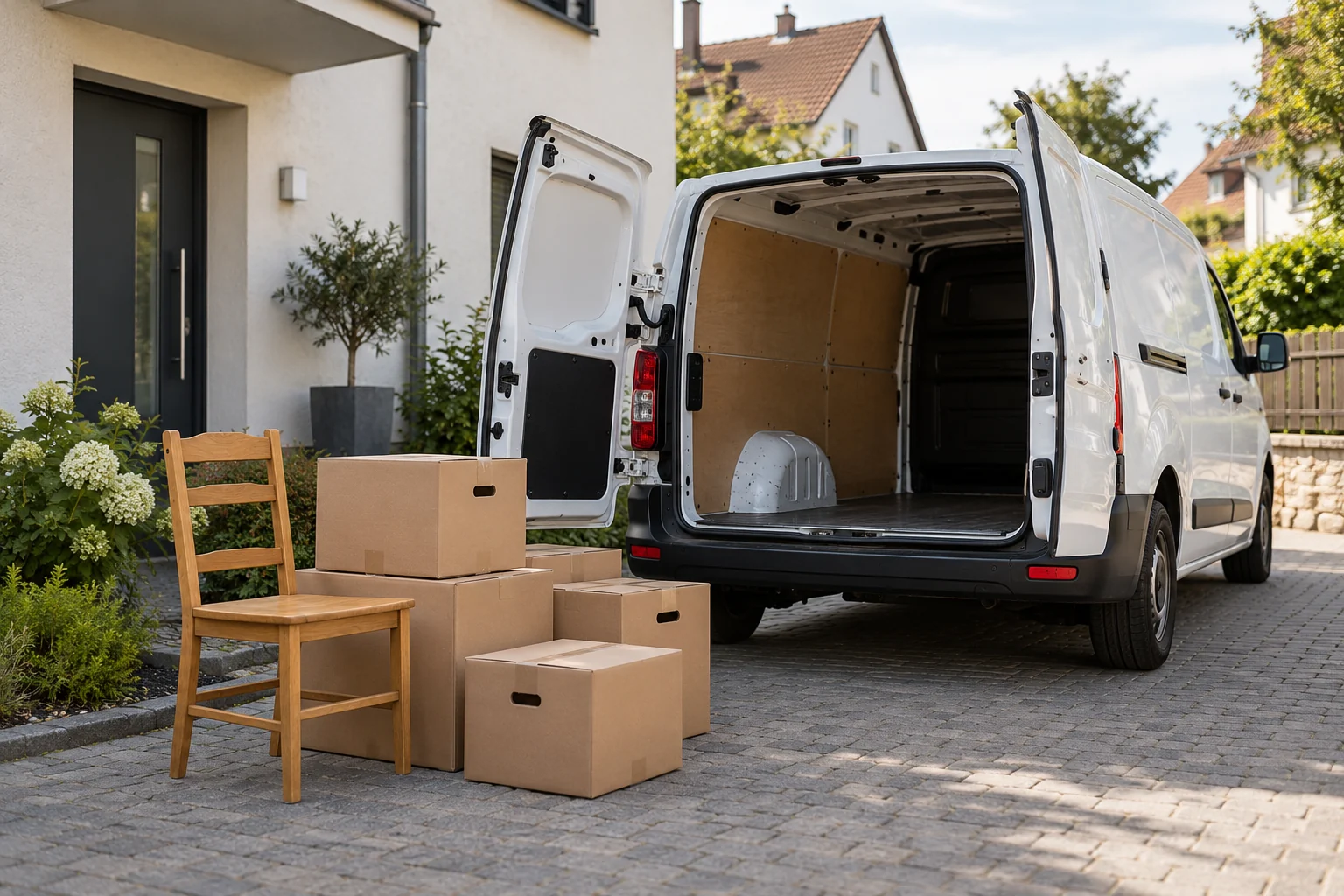
1. Decide what this small move actually includes
Are you leaving a furnished shared room with your own boxes, taking a few pieces from a flat or moving an entire small household? Record what you will take, leave behind or collect separately. Include the cellar, balcony, bicycle and the last items from the kitchen and bathroom in that decision.
Here, “one trip” means one loaded journey from the old address to the new one. Collecting and returning a hired vehicle, and any additional collection addresses, may add further journeys. This planning guide does not define a small move by a fixed box count or cubic-metre limit.
- Put each item in one of three groups: coming with you, staying behind, separate appointment.
- Allow for additional containers whose number and size are still unknown because packing is unfinished.
- Assign packing, dismantling, carrying, driving and assembly to a person or business.
2. Record items as they will actually travel
Measure external dimensions including protective packaging. Dismantled furniture becomes separate packages, including its fittings; assembled furniture still has protruding parts and a required transport orientation. Record known weights alongside dimensions and flag any unknown values.
The following list is a fictional, incomplete preparation example. It does not describe a customer move or establish a suitable vehicle size. A photograph helps an assessment but cannot replace a measurement of a critical piece of furniture.
| Example item | Information to record | Question still to resolve |
|---|---|---|
| 12 boxes | Each 60 × 40 × 35 cm; record the weight of each packed box. | Are more kitchen or book boxes still expected? |
| Dismantled desk | Top 140 × 70 × 4 cm; add legs and the fittings bag separately. | Check dimensions after edge protection and count every package. |
| Assembled armchair | 85 × 80 × 90 cm before protective packaging. | Will it pass through the flat door, stair landing and loading opening? |
| Mattress | 200 × 90 × 18 cm before protective packaging. | Check the manufacturer’s guidance on transport orientation and bending. |
3. Answer four separate vehicle questions
A larger load compartment does not automatically mean a higher permitted cargo weight. If weight remains uncertain, “it looks as though it fits” is not clearance to drive.
Will each package fit through the opening? Is there enough usable space for the complete arrangement? Is the permitted payload sufficient? Can everything be secured? You need reliable answers to all four before a volume figure becomes a transport plan.
ADAC’s fleet overview describes example models within vehicle classes and states that a specific model is not reserved. SIXT distinguishes interior dimensions from the smaller loading opening; wheel arches can reduce usable width. Have critical measurements confirmed for the vehicle actually supplied.
- Compare length, height, width between wheel arches and the loading opening with your largest packages.
- Account for cargo, occupants and equipment; check total mass and axle limits separately.
- Allow room for protective materials and suitable restraints; do not treat delicate items as freely stackable.
- Check the required driving entitlement, approved seats and vehicle height before booking.
4. Check both carrying routes and time windows
Follow the route from each large item to the possible loading position and, at the destination, into the new home. Record the floor, lift dimensions, narrow points, steps, distance and a lawful place to load and unload. A suitable van does not solve a staircase that is too narrow.
Coordinate keys, lift use and arrival with everyone involved. One trip only works in time if the destination is accessible after loading. Where measurements or heavy items raise doubts, establish in advance whether you need more help, dismantling or a different transport arrangement.
- Measure critical doorways and turns and photograph them from useful angles.
- Confirm helpers’ availability at both addresses and plan how they will travel separately.
- Clarify loading-space and lift arrangements instead of relying on finding them free.
5. One trip, two trips or a different vehicle?
Neither a short journey nor a second trip replaces load restraint. Section 22 of the German StVO requires loads to remain secured during hard braking or evasive manoeuvres.
One trip is plausible when the complete inventory, loading layout, weights and access all work together. If any of those remain unresolved, treat the number of trips as uncertain. A second journey should not become a surprise when you try to close the van doors.
A travel-time example only: if A to B takes 45 minutes in each direction, one loaded journey takes 45 minutes of driving. Two loaded journeys with a return from B to A take 135 minutes, or 90 minutes more. Loading, unloading, breaks, traffic and vehicle collection are excluded. This is not a forecast for your move.
| Option | May suit you when … | Resolve before choosing |
|---|---|---|
| One loaded journey | Every package fits in a safe arrangement within the weight limits. | Confirm the complete list, actual vehicle and destination access. |
| Two planned journeys | The distance and both time windows allow a return trip. | Plan the second load, intervening time, extra kilometres and renewed access. |
| A different vehicle | Individual dimensions or the complete arrangement do not fit the intended vehicle. | Recheck payload, driving entitlement, loading space and carrying routes. |
| A small move with a business | You lack the vehicle, driving experience or necessary carrying help. | Confirm inventory, journeys, staffing and excluded tasks in writing. |
6. Compare the whole job, not just the rental price
Compare options on the same basis: identical items, addresses, floors, packaging and division of work. Record rental duration, included mileage, excess mileage, fuel or charging, equipment and agreed help. For a moving business, the specification should include travel to the job, carrying, transport journeys and any additional tasks.
A refundable deposit initially ties up money and should be shown separately from expected spending. Check its refund conditions. Time matters too: a smaller vehicle may cost less to rent but make the overall job more demanding through return journeys or a longer hire period.
- For two trips, calculate the entire route including the return journey and vehicle drop-off.
- Check the rental deadline, key appointments and helpers’ available time together.
- If the inventory changes, reconfirm the price and agreed journeys in advance.
7. Finalise the plan before moving day
Send the final inventory, date, addresses, measurements and photographs to the named business or agree them with your private helpers. Record who packs, dismantles, carries, drives and assembles. State explicitly whether one journey is planned and how an additional load will be handled.
Before departure, compare the list with the actual load again. ADAC recommends suitable lashing straps; elastic bungee cords are unsuitable. Restraints and vehicle attachment points must suit the cargo. If a safe arrangement or the weight limits cannot be maintained, change the plan before driving.
- The evening before: count remaining boxes, confirm helpers and keys, and prepare hire or job documents.
- At the vehicle: check condition, dimensions, equipment and the agreed return arrangements.
- Before driving: check the load and doors; keep necessary documents accessible.
- At the destination: check packages against the inventory and record any agreed work still outstanding.
Questions about small moves
Is a small van always enough for one room in a shared flat?
No. A furnished room with boxes is different from a room whose bed, wardrobe and desk also need moving. The complete inventory, transport dimensions, weight, secure arrangement and access at both ends determine what is needed.
Can I calculate the number of trips from cubic metres alone?
No. Volume is an initial measure. Bulky individual items, the loading opening, wheel arches, stackability, weight limits and restraint options can restrict usable capacity.
Are two trips in a smaller vehicle cheaper?
That depends on distance, rental duration, mileage terms and help. Include the return to the old address and time for the second loading and unloading stages, and compare both options for the same task list.
What if everything does not fit on moving day?
Do not add unsecured items or exceed weight limits under time pressure. Arrange a second journey, another vehicle or a separate date, and confirm additional costs and access at both addresses.
Sources and scope
Checked on 6 October 2026. Fleet information provides orientation, not a promise of a particular vehicle or availability. The StVO is the German legal source on load restraint. The inventory, decision table and time example are editorial planning aids.