
Move planning · Building lift
Moving with a building lift: dimensions, access and timing
A lift in the building does not by itself make a moving quote reliable. Packed items must fit the entire route through entrances, corridors and cabin, and the lift must actually be available on the day. Prepare a separate access record for each address before booking.
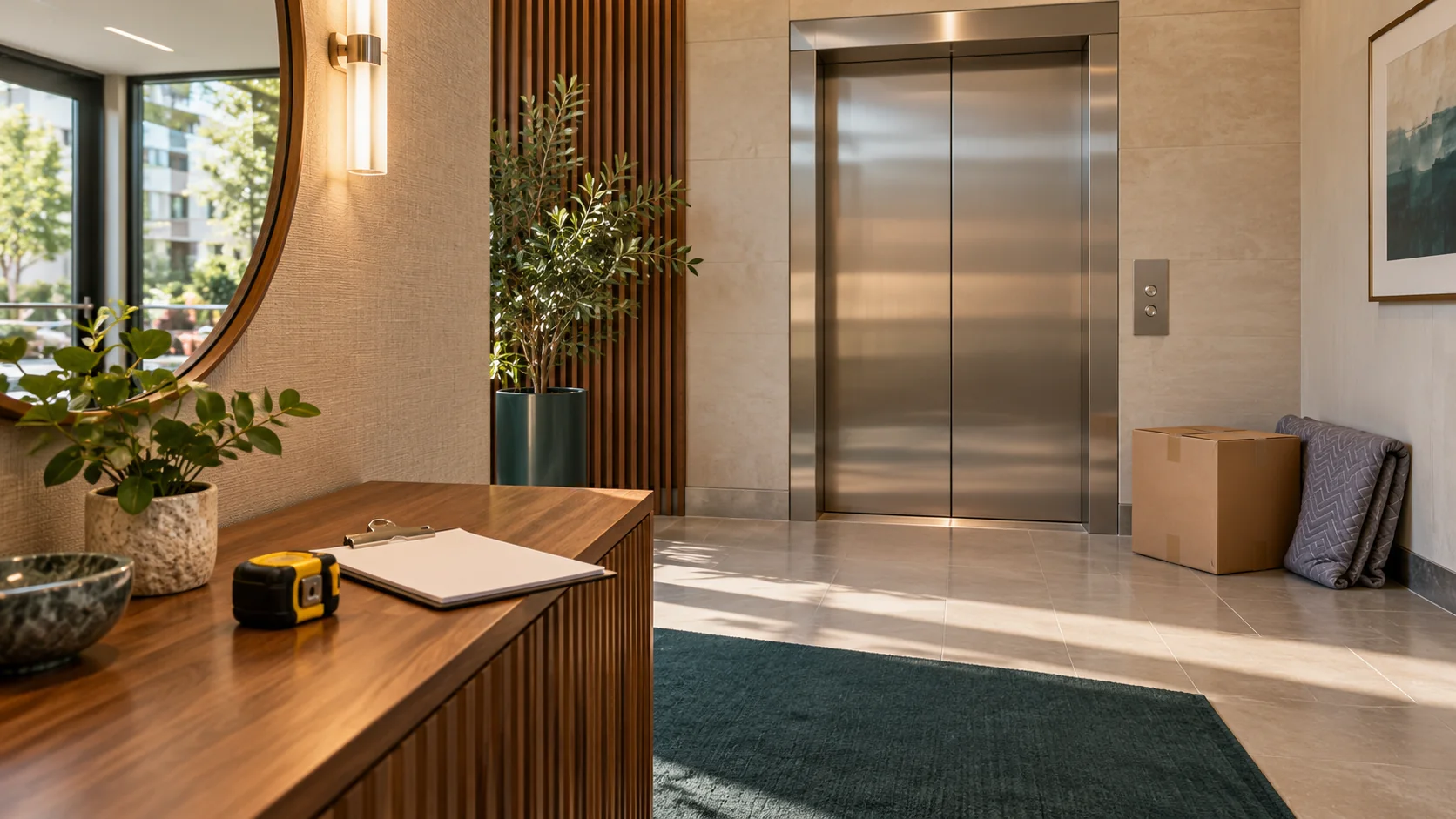
1. Check the complete route
Walk from the permitted loading position to the final furniture location. Record entrance steps, heavy doors, tight corners, the approach to the lift and the corridor on the destination floor. Some lifts stop at intermediate landings; include remaining stairs in the enquiry.
Assess the two addresses independently. A spacious lift at the old property does not solve a narrow entrance at the new one. Photograph constraints without including residents, nameplates or unnecessary personal information.
2. Measure usable openings
Measure the clear door opening rather than the frame. Record usable cabin width, depth and height, including fixed obstructions. Do not force doors open or operate safety devices. Ask the responsible person to establish any dimension that cannot be measured safely.
For each measurement, record what was measured, by whom and when. An old property listing cannot confirm current access.
| Check | Record | Reason |
|---|---|---|
| Entrance and apartment doors | Clear width, height and thresholds | The narrowest entrance may limit the whole route |
| Lift door | Clear width and height | The cabin may be larger than its entrance |
| Cabin | Usable width, depth, height and fixtures | Protection and handling require space |
| Before and after the lift | Corridor, turns, steps and landing | Furniture also needs room to turn |
3. Compare the packed furniture dimensions
Use dimensions including protective packaging, not just catalogue dimensions. Removable feet, handles and dismantled parts change the transport shape. Agree dismantling and reassembly first. The executing provider must assess any tilted orientation against the actual route.
Fictional example: the clear door width is 90 cm and the protected item is 94 cm wide in the intended orientation. A straight passage in that orientation is impossible. A calculated diagonal alone does not establish that the item can be turned into place.
| Example | Meaning | Next step |
|---|---|---|
| 90 cm opening; 94 cm packed item | 4 cm too wide in that orientation | Have another permitted orientation or dismantling assessed |
| Cabin appears large enough | Access and turning space remain unknown | Check the entire route |
| Missing dimensions | No confirmed transport solution | Obtain the missing information |
4. Confirm load limits and permitted use
Read the stated load limit and follow the lift operating instructions and building requirements. People and handling equipment contribute to the actual load. The passenger count is not a conversion chart for furniture. Resolve unknown weights or suitability before use.
A building lift is different from an external furniture hoist. An alternative lifting method requires separate assessment by a suitable provider. Do not interfere with controls, doors or safety systems.
5. Agree access with building management
Ask whether furniture transport is permitted and whether notice, a booking, protective measures or instruction are needed. Establish who supplies any required key and who is reachable on the day. Treat a reservation as valid only when confirmed.
Residents may still need the lift. Discuss waiting and shared spaces. Protective materials must not interfere with doors, sensors, controls or escape routes; the provider should agree the practical arrangement with the responsible person.
| Task | Contact | Record |
|---|---|---|
| Conditions and hours | Building manager | Confirmation, restrictions and contact |
| Protection and handling | Executing moving provider | Who supplies and installs protection? |
| Access on the day | Key holder | Availability and handover time |
| Changes and waiting | Contracting provider | Procedure and pricing if the plan changes |
6. Find the common access window
Combine lift availability, keys and loading access. Fictional example: lift use is agreed from 10 am to noon, but keys are available only at 11 am. The shared access window is at most one hour. This does not establish that an hour is enough for the job.
Trip count, waiting, walking distances and preparation depend on the actual move. Ask the provider to assess the schedule rather than converting a theoretical lift journey into a guaranteed total duration.
7. Agree a fallback for unavailability
Discuss who informs whom, what stays in place and whether a previously checked staircase could be used. Lift failure does not establish that the entire shipment can safely be carried upstairs.
Agree changed work, timing and possible costs with the contracting provider. Report a fault to the designated building contact or lift service. Do not attempt repairs or improvised rescue.
- Reconfirm access before moving day.
- Keep the building and moving-provider contacts available.
- Do not treat an unchecked alternative as an agreed service.
8. Request a partner through Umzughilfen
Umzughilfen is a marketing and referral service based in Idstein for enquiries in the Rhine-Main region. You can request selection of an independent moving partner. The named provider assesses access, handling and feasibility.
Send floor numbers, remaining steps, dimensions, usage conditions and time windows for both addresses, plus a list of bulky items. Quote, contract, work, invoice and payment are directly with the partner named in advance. Umzughilfen retains its own referral and data-protection obligations. An enquiry is not a booking.
Building-lift moving questions
Is “lift available” enough?
No. Doors, cabin, route to the apartment, load limit and actual availability must suit the move.
Can I rely on the cabin diagonal?
Not alone. The door, turning space, protection and safe handling may be more restrictive.
Can I reserve the lift throughout the move?
Ask building management. Do not assume exclusive use without confirmation.
Is carrying via the stairs automatically included after a breakdown?
There is no general answer. Agree feasibility, scope and possible costs with the contracting provider.
Who confirms that a large item fits?
Give measurements and photographs to the executing provider. An inspection or further assessment may be needed.
Planning notes
Editorial planning guidance, 23 October 2026. Numerical examples are fictional. The lift instructions, building requirements and executing provider’s assessment determine the actual arrangement.