
Packing · Rugs
Moving rugs: preparation, packing and unpacking
A rug seems straightforward until the finished roll has to turn on a staircase or find space among moving boxes. Plan more than rolling: include package length, surface protection, the separate underlay and the order of furniture placement. This guide covers loose rugs and runners; removing glued-down carpet is a different job.
1. Describe the rug and its new position
Give each rug an ID such as R01. Record its length and width when laid out, material from the label and features such as long pile, fringe, a stiff backing or previous repairs. Take an overall photo and record visible damage. If the material is unknown, say so; visual similarity is not enough to choose a care method.
Identify the destination room and check that the rug fits the planned furniture layout. List a non-slip underlay separately: it may have different dimensions and packing requirements. Use a documented weight where available. Leave an unknown weight as a question for the provider rather than estimating from area without construction details.
| Item | Measure or record | Purpose |
|---|---|---|
| Rug laid out | Length, width, material and condition | Choose placement and preparation |
| Finished package | Overall length and largest cross-section dimensions | Check access and vehicle space |
| Underlay | Dimensions, condition and separate packaging | Keep the set together at the destination |
2. Finish care before packing
The Canadian Conservation Institute recommends storing rugs clean and dry and warns about damage from sharp folds. Check the manufacturer’s guidance for your item. If cleaning is needed before moving, schedule it so the work and drying finish before packing, rather than while the vehicle is waiting.
Inspect the backing, edges and fringe as well as the face. Tell the packer about crumbling areas, weak seams and existing damage beforehand. Show a valuable or particularly fragile rug to an appropriate specialist before choosing how it will be handled. Do not try a new cleaning product on an unfamiliar backing on the final evening.
3. Choose packing to suit the condition
Not every textile can be rolled. CCI identifies limitations for weak, damaged and rigidly decorated items. Agree suitability, rolling direction, diameter and support based on the rug’s construction. Do not fold it in half first simply to create a shorter roll afterwards.
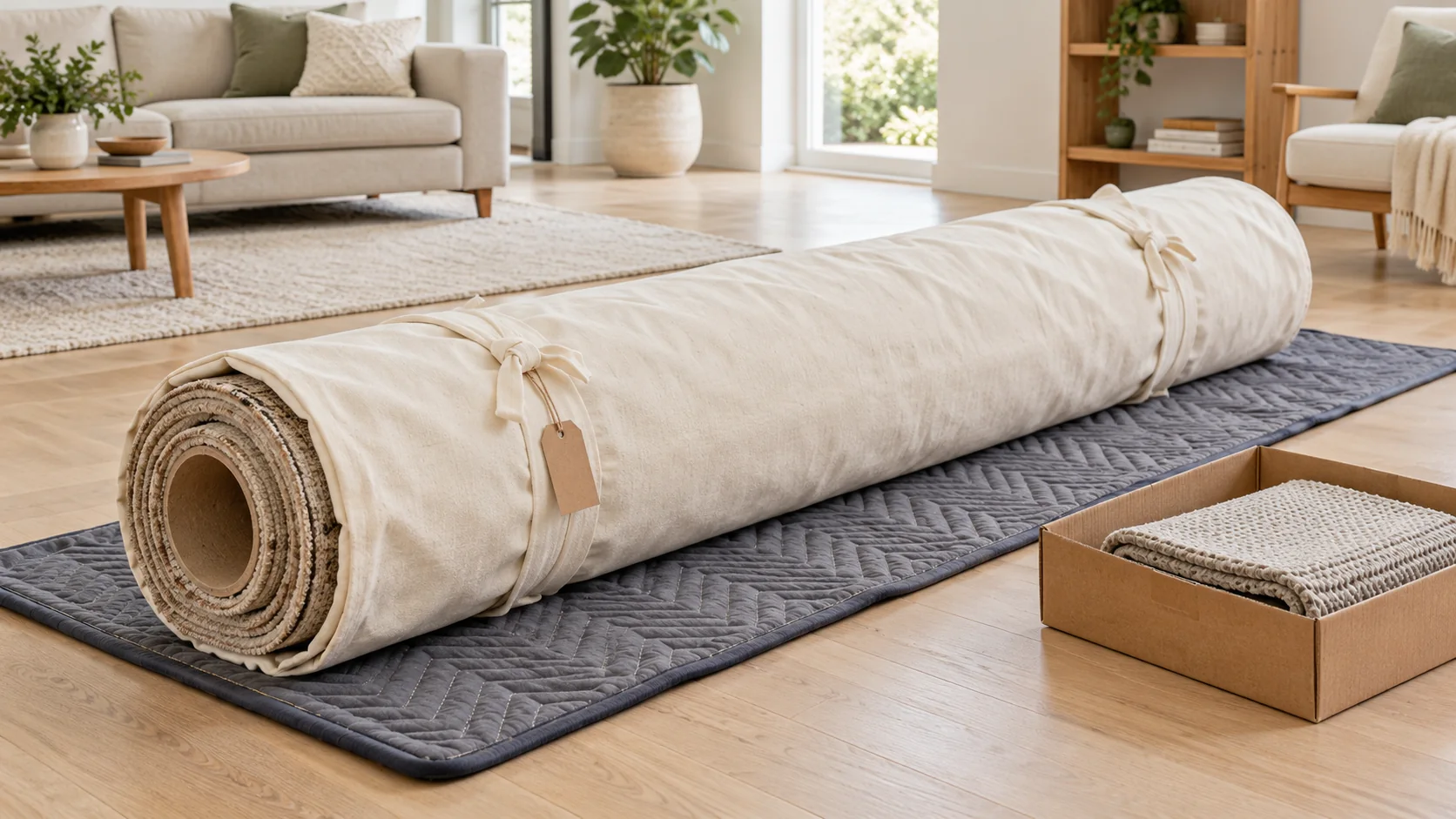
If rolling is selected, prepare a clean workspace and agree the packing system: inner support, compatible protective materials, outer cover and securing method. Support the item as work progresses; do not pull on fringe or weak edges. Packaging should preserve the chosen shape without a forced crease. Do not tighten it excessively to reduce the diameter.
Attach adhesive tape to the outer packaging rather than the rug itself. Plan protection on the way to the vehicle and while unloading in rain separately. After preparation, check that vulnerable areas are covered and update the finished measurements. A cover for a short journey is not automatically suitable for long-term storage.
4. Label the rug and underlay separately
Connect the ID on the outside label with the inventory and destination room. In this example R01 identifies the packed rug, while R01-U is the separately packed underlay. If the provider receives them as two packages, the inventory must show two packages even though they form one household set.
An illustrative finished-package entry is R01, length 215 cm, maximum width and height 28 cm each. These are example package measurements, not a calculation from the rug’s laid-out dimensions. For your move, record measured values including protruding support ends and end protection. Identify anything that needs to be laid out first.
| ID | Example description | What is counted |
|---|---|---|
| R01 | Rug · living room · 215 × 28 × 28 cm | One finished package; illustrative dimensions |
| R01-U | Underlay for R01 · living room | Another package if packed separately |
| In the inventory | Both IDs and the handover contact | Completeness and destination |
5. Check access for the long package
Roll length often tells you more than the assumption that a rug is soft and will fit. Check doorways, stair turns, the lift and vehicle access at both addresses using finished dimensions. Allow space for the people carrying it and agreed setting-down points outside the passage.
Show the carrier the finished roll or provide expected dimensions if packing will take place at the property. Agree carrying, supports, orientation and restraint in the vehicle. Do not plan heavy furniture on top of the roll. Report changed dimensions or an additional rug before loading so planning is not left at an earlier estimate.
6. Prepare somewhere to unpack
Before unloading, decide where packaging can be placed safely and when the rug can be laid out. The floor must be ready for that use; after renovation, check requirements for the floor covering and materials used. Do not unroll the rug amid ongoing dusty work or across a route still used for carrying heavy items.
Match the labels and inspect packaging and visible rug condition. Unroll using the agreed method without forcing damaged areas straight. Follow the underlay instructions and check compatibility with the floor. Before normal use, check edges and routes. Document visible damage and notify the contractual partner.
| Check | What needs to be clear |
|---|---|
| Floor and work area | Rug can be laid out and dusty work is complete |
| Rug and underlay | Set located, condition and compatibility checked |
| Edges and passages | Doors and walking routes remain usable |
7. Plan storage separately from transport
If the rug will not be laid out immediately, describe the waiting period and conditions at the intended location. Discuss packaging, support, access and condition checks with the person responsible for storage. A spare basement corner is not suitable merely because the roll fits. Assess room conditions and storage method separately from space requirements.
In the unloading plan, distinguish rugs needed immediately from those that should stay packed. Name the person who confirms when the room is ready. If the storage address or unpacking date changes, update the inventory and arrangements. The long package should not lose its destination between two stages of the move.
8. Give the partner specific rug information
Umzughilfen is a marketing and referral service based in Idstein for moving enquiries in the Rhein-Main region. Provide rug quantities, dimensions, known material, condition, underlays and packing requirements. Send photographs by a method agreed with your named contact; the enquiry form has no file upload.
The independent partner named in advance confirms feasibility and scope, supplies the quote, enters into the contract for the work with you, performs the work, invoices you and receives payment. Cleaning, special packing and storage are not included unless agreed. Umzughilfen retains its own referral and data-protection obligations. An enquiry is not yet a booking.
Questions about moving rugs
Can every rug be rolled?
No. Construction and condition determine the method. For weak, damaged or special items, agree a solution with an appropriate specialist first.
Are the laid-out rug dimensions enough?
No. Carrying and vehicle planning need finished package dimensions, including protruding support and end protection.
Does the underlay count as a separate package?
Yes, if packed and handed over separately. Connect its ID to the rug and list both packages.
When should the rug be laid out in the new home?
When the floor and room are ready and its position does not obstruct remaining work or routes. Agree the order before unloading.
Does this also cover glued-down carpet?
No. The guide concerns loose rugs and runners. Removing fixed floor covering requires a separate description and agreement on the work.
Sources and notes
Editorial guide dated 29 October 2026. Canadian Conservation Institute sources address rug and textile preservation. Selected general principles are used here; packing depends on the particular item and condition. R01 and 215 × 28 × 28 cm are illustrative, not standard allowances.